

Last Updated: October 25, 2026
Quick Summary
Build a creative capsule wardrobe by starting with an editing and buying checklist, then choosing two or three base colors plus one or two accent colors at an 80% base, 20% expression ratio. Most capsules land between 25 and 40 pieces including shoes but excluding accessories.
- Sort your closet with a checklist and remove anything with two no answers.
- Capsule size depends on your climate, your week, and your laundry habits.
- Every outfit fills four slots: base layer, bottom, outer layer, and footwear plus one accent.
- Five formulas crossed with six hero pieces gives 30 pre-approved outfits.
- Divide the price by how many times you wear a piece to track cost per wear.
Table of Contents
- Start With a Capsule Wardrobe Checklist Before You Shop
- How Many Pieces in a Capsule Wardrobe? Finding Your Number
- Pick a Base Color Palette, Then Break It on Purpose
- Creative Capsule Wardrobe Ideas That Go Beyond Neutrals
- Capsule Wardrobe Outfit Formulas You Can Repeat All Week
- Fit, Sizing, and Dress Codes: Make the Capsule Work for Your Life
- Track Cost per Wear and Refresh Your Capsule Each Season
- Add Your First Statement Piece From MobiusLDG
- Frequently Asked Questions
Start With a Capsule Wardrobe Checklist Before You Shop
A creative capsule wardrobe is a small, intentional set of clothes that mix freely, built around pieces you actually love. At MobiusLDG, we think of it as a wardrobe with a point of view, not a beige uniform.
Most people build one backwards. They buy first, then wonder why nothing works together.
The fix is a checklist. Two checklists, actually: one for editing what you own, one for buying what you need.
The Editing Checklist: What Stays and What Goes
Pull everything out. Yes, everything. Then sort with these questions:
- Does it fit right now, not "someday"?
- Have I worn it in the last year?
- Does it work with at least three other pieces?
Anything with two "no" answers leaves. Be honest about the "someday" pile. It rarely shrinks.
The Buying Checklist: What to Add Next
Before any purchase, run this list:
- Can I name three outfits it completes?
- Does it match my base color palette?
- Will I still want it in two years?
A common mistake is buying a statement piece with nothing to wear it against. Buy the foundation first.
How Many Pieces in a Capsule Wardrobe? Finding Your Number
There is no magic number.
Your number depends on three things: your climate, your week, and your laundry habits.
Ask yourself:
- How many days a week do you dress for work versus home?
- Do you have four distinct seasons or two?
- How often do you actually do laundry?
A person working from home needs fewer structured pieces. Someone in a cold climate needs more layers.
Start with a number you can manage. You can always add.
Here are the numbers the article gives for sizing a capsule to your own life.
| Item | Value | Note |
|---|---|---|
| Typical capsule size | 25 to 40 pieces | Includes shoes, excludes accessories |
| What sets your number | Climate, week, laundry habits | Three factors named in the article |
| Work-from-home wardrobe | Fewer structured pieces | Stated as an example |
| Cold climate wardrobe | More layers | Stated as an example |
| Laundry-averse wardrobe | More tops | Stated as an example |
Pick a Base Color Palette, Then Break It on Purpose
Here is the part most guides get wrong: a creative capsule wardrobe is not a neutral capsule wardrobe.
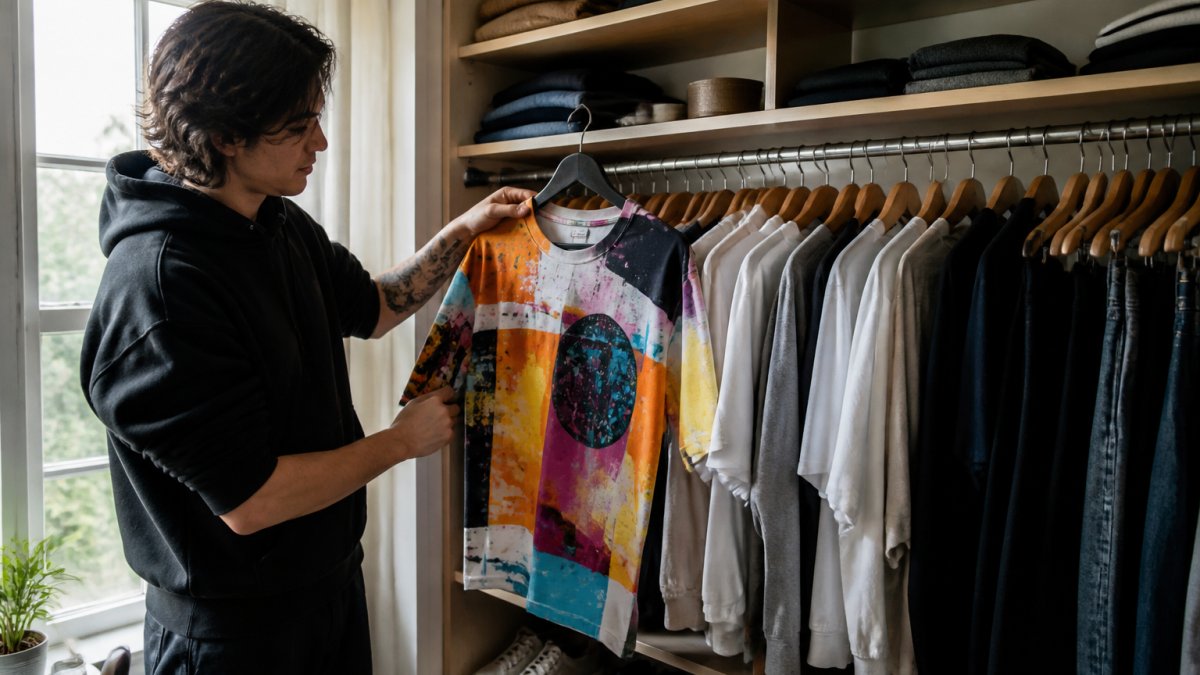
Pick two or three base colors for your tops, bottoms, and outerwear. Think navy, charcoal, cream, olive, or denim blue. These do the heavy lifting.
Then choose one or two accent colors you genuinely love. Not what's trending. What makes you smile in the mirror.
The rule is simple: 80% base, 20% expression. That ratio keeps outfits cohesive while leaving room for personality.
If you want to go deeper on balancing restraint with self-expression, our guide on how to incorporate art into a minimalist wardrobe walks through the exact approach.
Creative Capsule Wardrobe Ideas That Go Beyond Neutrals
The fastest way to make a capsule feel creative is to let one piece carry the outfit. Everything else supports it.
Try these approaches:
- Art-led tops. A graphic tee becomes the focal point. Pair it with plain jeans or trousers and let it speak.
- Unexpected color blocking. One bright piece against two quiet ones.
- Texture over pattern. Swap a print for a rich fabric like garment-dyed cotton.
Let One Art Piece Lead the Outfit
Pick the piece first, then build around it. If your top is loud, keep the bottom plain.
This is the core of creative capsule wardrobe ideas that actually get worn: one hero, everything else in support.
If abstract prints are your thing, our article on incorporating abstract art into everyday style shows how to wear them without feeling overdone.
Abstract Art Unisex Garment-Dyed T-shirt →
Capsule Wardrobe Outfit Formulas You Can Repeat All Week
Formulas save decision fatigue, but a bare list of five combinations does not show you why they work or how far they stretch. The point of a formula is that it is a slot machine: fixed structure, rotating pieces. Once you see the structure, a 30-piece capsule stops feeling small.
The Four-Slot Structure
Every outfit in a creative capsule fills four slots:
- Base layer, the piece against your skin (tee, button-down, turtleneck, hoodie)
- Bottom, jeans, trousers, skirt, shorts
- Outer layer, blazer, overshirt, cardigan, jacket (optional in warm weather)
- Footwear + one accent, shoes plus a bag, scarf, hat, or jewelry
If you have 8 tops, 5 bottoms, 3 outer layers, and 4 shoe options, the raw combination count is 8 × 5 × 3 × 4 = 480 outfits before you even touch accessories. You will not wear 480, but the math shows why 25-40 pieces is not a constraint, it is a filter.
Five Formulas, With the Logic Behind Each
- Graphic tee + straight jeans + sneakers. The hero is the tee. Keep the jeans and sneakers quiet so the graphic reads. Works for errands, casual Fridays, weekends.
- Plain tee + patterned trousers + loafers. Inverts formula 1: the bottom is the hero, the top is the frame. Good for creative offices and dinners.
- Hoodie + tailored trousers + clean sneakers. The high-low contrast is the creative move, casual top, structured bottom. This is the formula most capsule guides skip, and it is the one that reads most modern.
- Button-down + statement bottom + simple shoes. A button-down is the most versatile top in a capsule because it works tucked, untucked, open over a tee, or tied at the waist.
- Layered tee + blazer + jeans. Layering adds visual depth without adding a new hero piece. Swap the tee color to change the whole outfit.
The Rotation Matrix
Write your formulas down the side of a page and your hero pieces across the top. Check the box when a pairing works. A filled matrix of 5 formulas × 6 hero pieces gives you 30 pre-approved outfits, a full month of getting dressed without a decision.
How to Stretch a Formula Without Buying Anything
- Swap the shoe. The same tee-and-jeans formula reads casual with sneakers, sharp with loafers, and evening-adjacent with a low boot.
- Swap the outer layer. A blazer turns formula 1 into a work outfit; an overshirt turns it into a weekend outfit.
- Change the tuck. Tucked, half-tucked, and untucked are three different silhouettes from one shirt.
For more concrete combinations built around art-led tops, our guide on styling artistic graphic tees breaks down seven outfit ideas you can copy.
Fit, Sizing, and Dress Codes: Make the Capsule Work for Your Life
A capsule only works if it fits your body and your obligations. Most guides treat fit as a checklist and dress codes as an afterthought. This section treats both as design inputs, because a creative capsule that ignores either one becomes a closet of unworn good intentions.
Fit Is Not One Thing
"Good fit" means different things on different bodies, and a capsule should be built around the fit language that already works for you, not around a generic ideal. Before you commit to any piece, check the four seams that matter most:
- Shoulder seam sits at the edge of your shoulder bone, not past it and not inside it.
- Sleeve length ends where you want it, wrist, mid-forearm, or deliberately cropped, and stays there when you move.
- Waistband feels comfortable seated, not just standing. Sit down in the fitting room. If you have to unbutton, it fails.
Sizing Strategy Across Brands
Sizing is not consistent across brands, and it is not supposed to be. Measure yourself once, bust or chest, waist, hip, inseam, and shoulder width, and keep the numbers in a note on your phone. Then shop by measurement, not by the number on the tag. A common pattern is that the same person wears three different sizes across three brands; that is normal, not a failure.
Dress Codes: Split the Capsule, Not Your Personality
If your workplace leans conservative, do not force the creative energy into a setting that will not receive it. Split the capsule into two zones that share a base:
- Work zone: the base colors, structured bottoms, button-downs, and one quiet accent.
- Off-hours zone: the graphic tees, statement bottoms, and louder accessories.
The shared base is what makes it one capsule instead of two wardrobes. A navy trouser can anchor a conservative work outfit on Tuesday and a hoodie-and-sneakers outfit on Saturday.
Fit for Different Bodies and Needs
A few practical adjustments that make a capsule more inclusive without changing its structure:
- If you are tall or long-limbed, prioritize brands with tall sizing and treat sleeve and inseam length as non-negotiable; a cropped sleeve on a long arm reads as a mistake, not a style choice.
- If you are petite, cropped jackets, high-rise bottoms, and monochrome outfits elongate the line; avoid oversized outerwear that swallows the frame.
- If you are plus-size, look for garments with real ease through the hip and upper arm, and prefer fabrics with some stretch or drape over stiff weaves that pull at the seam.
The Fitting-Room Test
Before any piece joins the capsule, do five things in the fitting room: sit, reach overhead, bend forward, walk ten steps, and check the mirror from the back. If it passes all five, it is a candidate. If it fails one, leave it, the capsule has no room for pieces that only work standing still.
Our piece on styling artistic clothes for conservative dressers covers the work-zone split in more detail.
Track Cost per Wear and Refresh Your Capsule Each Season
Cost per wear is simple math: divide the price by how many times you wear it. A piece worn fifty times costs far less per wear than one worn twice.
Keep a simple note on your phone. Log each piece and a rough wear count. After a season, you will see what earns its place.
Then refresh, don't rebuild. At each season change:
- Retire what you did not wear
- Restock basics that wore out
- Add one or two new statement pieces
This keeps the capsule alive without starting over.
Add Your First Statement Piece From MobiusLDG
Start with one piece that makes the whole capsule feel like yours. Our Abstract Art Unisex Garment-Dyed T-shirt is a natural first pick: 100% ring-spun cotton, a relaxed fit, and double-needle stitching built to hold its shape.

If you want something softer on the wallet, the Kelp Mirror Back tee runs $28.83, and the Psychedelic Dog pocket tee is $28.22. For cooler months, the Hummingbird hoodie is $40.12.
Each design starts as art, then gets printed onto garments we would wear ourselves.
Frequently Asked Questions
What is a creative capsule wardrobe?
A creative capsule wardrobe is a small, mix-and-match set of clothes built around a base color palette, with a few statement pieces that carry real personality. Instead of 40 neutral items, you might run 25 to 35 pieces where two or three art-driven tops or prints do the expressive work. The goal is the same as any capsule: fewer decisions, more outfit combinations. The difference is that the capsule reflects a specific point of view rather than blending in.
How many pieces should a capsule wardrobe have?
Most capsules land between 20 and 40 pieces, including tops, bottoms, layers, shoes, and accessories. A work-focused capsule usually needs more tops and layers, while a casual one can run leaner. Count everything you wear in a normal two-week stretch and use that as your baseline. If you are just starting, 25 pieces is a workable target: roughly 10 tops, 6 bottoms, 4 layers, 3 pairs of shoes, and 2 accessories.
What is the 3-3-3 rule for wardrobe planning?
The 3-3-3 rule is a packing and planning shortcut: three tops, three bottoms, and three pairs of shoes, which produces 27 outfit combinations before you add layers or accessories. It works well as a test run for a capsule because it forces you to check whether your pieces actually mix. If a top only works with one bottom, it fails the test. Use it for a week-long trip or as a trial before committing to a full capsule.
How do I add color and personality without buying a whole new wardrobe?
Keep your existing neutrals and add two or three expressive pieces that share a color already in your palette. A garment-dyed graphic tee, a printed scarf, or a bright layer can shift the mood of five or six outfits without replacing anything. Check that each new piece works with at least three items you already own. That single rule keeps a creative capsule cohesive instead of turning into a pile of one-off purchases.
Building a creative capsule wardrobe takes one honest closet edit and one good statement piece. If you are ready to start, browse the MobiusLDG collection and find the design that feels like you. Subscribe to our emails for first looks at new pieces.
