

Table of Contents
- Start With Fit: The Foundation of Every Artistic Graphic Tee Outfit
- How to Layer Graphic Tees Without Hiding the Artwork
- Styling Graphic Tees for Work: Elevated Casual That Passes
- Skirts, Denim, and Footwear: Pairings That Let the Print Lead
- Artistic Graphic Tees for Sale 2026: What to Look For
- Body-Type Styling, Capsule Wardrobes, and Print Care
- Conclusion
- Frequently Asked Questions
Last Updated: September 14, 2026
Start With Fit: The Foundation of Every Artistic Graphic Tee Outfit
Fit decides whether an artistic graphic tee reads as intentional or accidental. This MobiusLDG guide covers the 2026 outfit formulas, plus the fit, care, and capsule rules that keep those tees in rotation.
Artistic graphic tees are cotton tops printed with original artwork rather than brand logos or slogans. The print is the point, so the styling job is to frame it, not compete with it.
Two silhouettes dominate. The oversized fit drapes past the hip with dropped shoulders, suiting streetwear and layering. The cropped or regular fit sits closer to the torso and hits at or above the waistband, easing tucking and tailoring.
Oversized vs. Cropped: Choosing Your Silhouette
Pick based on what sits below the tee. An oversized graphic tee needs a slimmer bottom half: straight-leg denim, a pencil midi, or leggings. A cropped tee needs volume: wide-leg trousers or a maxi skirt.
For a first purchase, a regular or relaxed fit is safer: it tucks, knots, and layers without fighting the garment. An oversized tee adds contrast that modernizes structured pieces.
How to Layer Graphic Tees Without Hiding the Artwork
Layering is where most people lose the print. Every layer above the tee should frame the artwork, not cover it: a jacket worn open creates a vertical frame; worn closed, it erases the design.
Start with the tee as your base layer. Add an unbuttoned shirt or light knit so the graphic sits in the open V, then an outer layer, also worn open. Three layers is the ceiling.
Blazers, Jackets, and the Tuck That Ties It Together
A blazer over a graphic tee is the fastest route to elevated casual. Choose a relaxed, unstructured blazer in a solid color so it doesn't compete with the print. A denim jacket reads more casual; leather or bomber pushes toward edgy.
The tuck matters more than the jacket. A full tuck into high-waisted trousers reads polished; a front tuck reads relaxed and works with almost any bottom; a side knot suits cropped or regular fits over a midi skirt.
- Full tuck: high-waisted trousers, tailored shorts, midi skirts
- Front tuck: straight-leg denim, wide-leg pants, layered over a longer shirt
- Side knot: maxi skirts, high-rise jeans, warm-weather outfits
Styling Graphic Tees for Work: Elevated Casual That Passes
Styling graphic tees for work comes down to three filters: print, fit, and finish. A recognizable artistic print in muted colors, a clean fit, and a structured bottom half passes in most business-casual offices. Loud slogans, distressed hems, and oversized fits generally won't.
Build the outfit around a regular-fit tee in a neutral or single-color print. Tuck it into tailored trousers or a midi skirt, add a blazer, and finish with loafers or clean leather sneakers. Keep jewelry minimal.
The print itself carries the weight here. An abstract or painterly design reads more professional than a cartoon or text-heavy graphic, which is why the Cleveland Museum of Art's guide to print and pattern in design is useful background if you're deciding which artwork translates to a workplace setting.
| Workplace Context | Print Style | Fit | Bottom Half |
|---|---|---|---|
| Business casual | Abstract, muted, single-color | Regular, tucked | Tailored trousers, midi skirt |
| Creative office | Bold artistic, painterly | Oversized, front tuck | Straight-leg denim, wide-leg pants |
| Casual Friday | Any graphic, including text | Cropped or regular | Jeans, casual skirt |
| Client-facing | Minimal or no visible graphic | Regular, tucked | Suit trousers, structured skirt |
Skirts, Denim, and Footwear: Pairings That Let the Print Lead
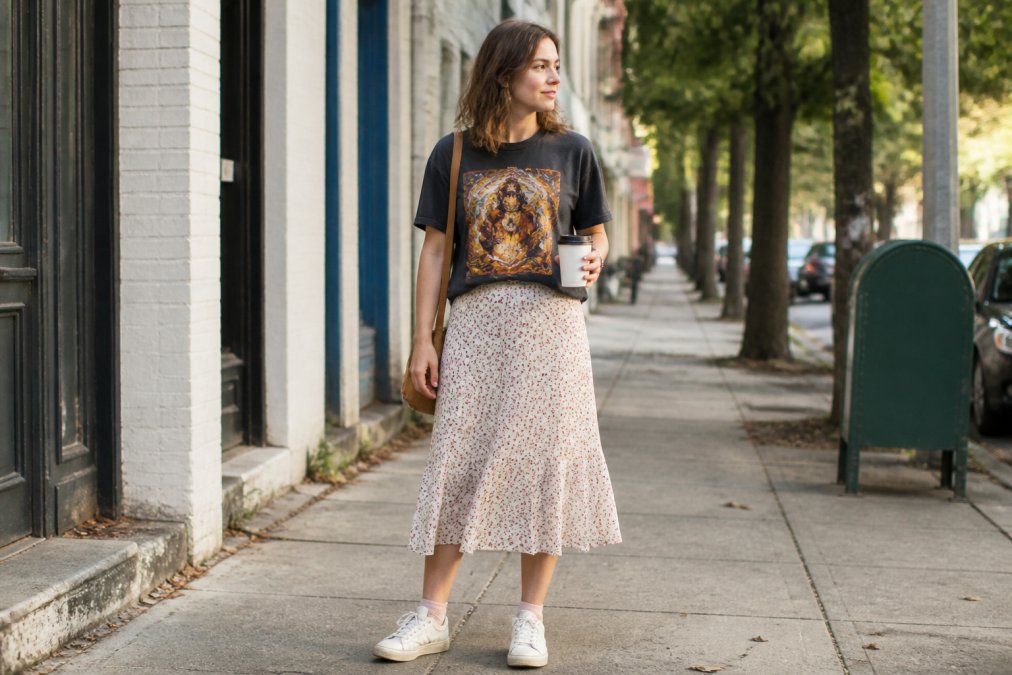
Skirts and denim do the heavy lifting once the tee is chosen. A solid midi skirt gives the print room to breathe; a mini works best with a cropped or knotted tee; a maxi pairs with an oversized tee and front tuck for a relaxed, vintage look.
Denim is the default for a reason. Straight-leg and wide-leg cuts balance an oversized tee; skinny jeans suit a cropped fit. For a more elevated look, swap denim for neutral tailored trousers.
Skirt Pairings by Silhouette
- Midi skirt (solid, A-line or bias-cut): The safest pairing for a bold print. The solid color gives the artwork a neutral field, and the midi length keeps the outfit from reading as a costume. Works with a full or front tuck.
- Mini skirt (denim, leather, or pleated): Reads younger and more casual. Best with a cropped or side-knotted tee so the waistline stays visible; an oversized tee needs a front tuck.
- Maxi skirt (flowing, solid, or subtle pattern): Pairs with an oversized tee and a front tuck for a relaxed, vintage look. Avoid a large competing pattern; the tee print is the focal point.
- Pencil skirt (structured, midi length): The most office-friendly pairing. Requires a regular or cropped fit and a full tuck; an oversized tee reads sloppy, not relaxed.
Denim Pairings by Cut
- Straight-leg: The universal pairing. Balances an oversized tee and works with a front or full tuck.
- Wide-leg: Adds volume at the bottom, so pair with a cropped or regular tee. A front tuck works; a full tuck can look bulky.
- Skinny: Suits a cropped or regular fit. An oversized tee over skinny jeans reads top-heavy unless tucked.
- Barrel or relaxed: A newer cut that pairs with a regular fit and a full tuck; ankle volume balances hip volume.
Footwear Sets the Register
- Sneakers (clean leather or canvas): Keep the outfit casual and are the safest choice. A white leather sneaker reads more elevated than a running shoe.
- Loafers (leather, chunky sole): Shift toward elevated casual. Best with a tucked regular tee and tailored trousers or a midi skirt.
- Ankle boots: Work with a cropped tee and midi skirt in transitional weather. A pointed toe reads dressier; a lug sole more casual.
- Heels (block or kitten): A knotted tee with a maxi or midi skirt and a heel creates an evening outfit with no change of clothes. A stiletto usually reads mismatched.
- Ballet flats: A practical middle ground for a tucked regular tee and midi skirt. More polished than a sneaker without the formality of a heel.
Day-to-Night: One Tee, Two Outfits
The fastest way to move an artistic graphic tee from daytime to evening is to change three things: the bottom, the shoe, and the outer layer. The tee stays.
- Daytime: Oversized tee, straight-leg denim, white sneakers, denim jacket worn open.
- Evening: Same tee, front-tucked into a solid midi skirt, block heels, and a structured blazer or leather jacket worn open.
The print does not need to change, only the formality of everything around it. A muted or single-color print transitions more easily than a loud multicolor one, making it the better investment for double duty.
Seasonal Adjustments
The same tee works year-round if you adjust the layers, not the tee.
- Spring: Regular or cropped fit, midi skirt or straight-leg denim, sneakers or ballet flats, no outer layer or a light denim jacket.
- Summer: Cropped or regular fit, mini skirt or shorts, sneakers or sandals. A side knot keeps the tee off the waistband in heat.
- Fall: Oversized fit, straight-leg or wide-leg denim, ankle boots, and a denim or bomber jacket worn open.
- Winter: Oversized fit under a heavy coat worn open, with a thermal underneath. The graphic should stay visible in the open V; if it isn't, the layering has gone too far.
Artistic Graphic Tees for Sale 2026: What to Look For
Shopping for artistic graphic tees in 2026 means checking three things: print method, fabric weight, and design originality. Direct-to-garment (DTG) printing bonds ink into the cotton fibers rather than laying a plastic film on top, so it holds up better through repeated washing than heat-transfer prints.
Fabric weight matters too. Ring-spun cotton feels softer and prints more cleanly than standard cotton, and garment-dyed tees carry a broken-in color from the first wear. If a listing doesn't state print method or fabric, keep looking.
Original artwork is the third check. Mass-produced graphic tees recycle stock designs across dozens of sellers; a curated collection draws from named artists and one-off illustrations. MobiusLDG's range includes pieces like the Abstract Art Unisex Garment-Dyed T-shirt, the Alebrije Dog Unisex Jersey Short Sleeve Tee, the Van Dogh Unisex Ultra Cotton Tee, and the Vesica Matisse Unisex Jersey Short Sleeve Tee, each built on a different artist's work.


Body-Type Styling, Capsule Wardrobes, and Print Care
Most styling guides stop at the outfit. The sections below cover the three things that decide whether an artistic graphic tee stays in rotation: silhouette fit, capsule integration, and print care.
Body-Type Styling: Where the Eye Lands
Body-type styling for graphic tees comes down to one question: where do you want the eye to land first? The print is a visual anchor, so use it to draw attention up, down, or across depending on cut and tuck.
- Broader shoulders or a strong upper body: A V-neck, scoop neck, or open crew softens the shoulder line. Avoid boat necks and cap sleeves. A front tuck into straight-leg denim keeps the vertical line clean.
- A longer torso or shorter legs: A cropped or regular fit ending at or just above the waistband shortens the torso and lengthens the leg. Pair with high-rise bottoms; an untucked oversized tee will read as a dress.
- A shorter torso or longer legs: An untucked oversized tee, or a regular fit with a side knot, balances proportion. A full tuck into high-waisted trousers can compress the torso.
- A fuller bust: A scoop or V-neck keeps the print visible instead of stretching across the chest. A high crew neck with a large chest print can distort the artwork.
- A straighter silhouette: A cropped tee over a high-waisted bottom creates a waistline where there isn't one; a side knot does the same on a regular fit.
- A curvier lower half: An oversized tee with a front tuck over a midi or wide-leg bottom balances the frame; a tight cropped tee over a bodycon skirt emphasizes contrast instead.
The tuck is the most adjustable variable. A full tuck reads polished with high-waisted bottoms; a front tuck reads relaxed and works on almost everyone; a side knot adds waist shape and is the most forgiving option.
Capsule Wardrobe Integration
A graphic tee is not a trend piece if you build the wardrobe around it. The capsule math is simple: three artistic tees, two bottoms, one blazer, one jacket, and two pairs of shoes generate more than a dozen outfits.
The rule that makes it work is a shared color family. If all three tees pull from the same palette, say, black, cream, and a single accent, they mix with the same bottoms and outerwear without conscious matching. A loud multicolor print is a standalone piece, not a capsule piece.
A practical three-tee capsule: one neutral or single-color print for work, one bold painterly or abstract print for weekends, and one oversized graphic for layering. Two bottoms, straight-leg dark denim and a solid midi skirt, cover most of the calendar. One unstructured blazer and one denim or bomber jacket handle outerwear. Clean leather sneakers and loafers or ankle boots set the register.
Print Care: The Part That Decides Longevity
High-quality artistic prints fail in predictable ways. The two biggest threats are heat and friction, both from the wash cycle, not from wearing the tee.
- Wash inside out in cold water. The inside-out turn protects the print from rubbing against other garments; cold water keeps ink from softening and lifting.
- Skip the dryer. Heat cracks a DTG or screen print. Air-dry flat or hang dry; if you must use a dryer, use the lowest heat and remove the tee while slightly damp.
- Never iron directly on the print. Iron the reverse side or place a cotton cloth between the iron and the artwork; direct heat will fuse or gloss the ink.
- Avoid fabric softener and bleach. Both break down the binder holding pigment to the cotton fiber. A mild detergent is enough.
- Store folded, not hung. Hanging a heavy cotton tee on a wire hanger stretches the shoulders and can crease the print. Fold and stack.
the American Cleaning Institute's fabric care guidance covers the general principles for cotton, and the Textile Museum's notes on dye and pigment stability explains why heat and friction are the two biggest threats to a printed design.
Sustainable Sourcing Without the Label
A tee you wear for five years is the most sustainable tee you can own, which makes print durability and fabric quality the real environmental levers, not the tag's certification. When comparing two artistic graphic tees, ask: what is the print method, what is the fabric weight, and will the design still feel current in three years? A garment-dyed ring-spun cotton tee with a DTG print that survives a hundred washes outlasts three fast-fashion graphic tees with heat-transfer prints.
Conclusion
The hard part isn't finding an artistic graphic tee; it's building a rotation you'll actually wear past the first month. MobiusLDG curates art-inspired tees, prints, and accessories designed to slot into a real wardrobe, with original designs, garment-dyed and ring-spun cotton options, and unisex fits. Subscribe to MobiusLDG's emails to see new artwork as it drops and get first access to restocks.
Frequently Asked Questions
What is the best way to style a graphic tee so it looks intentional?
Start with fit, then build one focal point. Tuck the front hem into high-waisted denim or a midi skirt to define your waist, add a structured layer like a blazer, and keep accessories minimal so the artwork stays the statement. Choosing a tee with a relaxed but not baggy silhouette helps too. MobiusLDG's Abstract Art Unisex Garment-Dyed T-shirt, at $43.83, has a relaxed fit that tucks cleanly without bunching.
How do I layer a graphic tee without covering the design?
Wear open layers so the print stays visible: an unbuttoned flannel, a denim jacket left open, or a blazer with the sleeves pushed up. If you add a crewneck sweater, choose a wider neckline so the graphic peeks through. Knotting a button-down at the waist over a tee also works. The goal is framing the artwork, not hiding it.
Can I wear an artistic graphic tee to work?
Yes, in most smart-casual offices. Pair it with tailored trousers or a midi skirt, add a blazer or structured cardigan, and choose a print that reads as art rather than a slogan. Keep the rest of the outfit neutral. If your workplace is more formal, save the boldest prints for casual Fridays and stick to smaller, abstract designs on regular days.
How should I care for artistic graphic tees so the print lasts?
Turn the shirt inside out, wash cold on a gentle cycle, and skip the dryer, since heat is what cracks and fades prints. Hang or lay flat to dry. Avoid ironing directly on the design; if you must press it, use low heat on the reverse side. Following these steps keeps the artwork sharp and the cotton soft for years, which matters when you've paid for a distinctive print.