

Table of Contents
- Start With a Minimalist Capsule Wardrobe Foundation
- A Practical Framework for Choosing Art That Fits Your Minimalist Wardrobe
- How to Add Color to a Minimalist Wardrobe Without Breaking the Palette
- Artistic Graphic Tees: The Easiest Entry Point
- Styling Statement Pieces With Neutral Basics
- Art Beyond Printed Clothing: Scarves, Accessories, and Home Pieces
- Sourcing, Care, and Longevity of Artistic Garments
- Conclusion: Build a Wardrobe That Feels Like You
- Frequently Asked Questions
Last Updated: October 5, 2026
Start With a Minimalist Capsule Wardrobe Foundation
A minimalist wardrobe is a small, carefully chosen set of clothes that all work together, so you can get dressed fast and still look put together. Start with a simple core, not a shopping spree.
The 7 to 8 Piece Core You Actually Wear
Start with seven to eight pieces you reach for again and again, your minimalist capsule wardrobe base.
- Two plain tees in neutral colors
- One button-down shirt
- One pair of dark straight-leg trousers
These pieces mix and match on their own, giving every artistic item a calm backdrop.
A Practical Framework for Choosing Art That Fits Your Minimalist Wardrobe
Choosing art for a minimalist wardrobe comes down to three tests: does it match your palette, does it fit the space on your body, and does it feel like you? Pass all three and it belongs.
Run every piece through this checklist before you buy:
- Does the main color fit your neutral palette?
- Is the artwork one clear focal point, not five competing ones?
- Does the print size suit where you'll wear it?
If a piece fails two or more boxes, leave it. A minimalist wardrobe rewards restraint.
Scale, Proportion, and Visual Impact
Where art sits on a garment changes how bold it looks: a small chest print reads as a quiet detail, a full-front design becomes the whole outfit.
Match the scale to your frame and the occasion:
- Small chest prints feel subtle and work-friendly
- Medium back or front prints suit casual days
- Large all-over designs are your loudest option, so keep the rest plain
The Fashion Institute of Technology's fashion and textile resources notes that proportion and balance are central to how a garment reads on the body. Use that idea: let one piece carry the visual weight.
How to Add Color to a Minimalist Wardrobe Without Breaking the Palette
Most minimalist guides say "add a pop of color" and stop there, which is why so many capsule wardrobes look flat or chaotic. The real skill is choosing which color, how much, and where it lands on the body.
Start With a Two-Tier Palette
Split your wardrobe into two tiers before buying anything colorful.
- Tier 1, Base neutrals (about 80% of your closet): black, white, off-white, gray, navy, and tan or camel. These are the pieces you wear most and the ones every colorful item has to sit against.
- Tier 2, Accent colors (about 20%): one or two colors you actually love, plus one metallic (gold or silver) that acts as a neutral in jewelry and hardware.
Stylists often pick accent colors already present in your skin tone, hair, or eyes. Colors that flatter you at the face level are the ones you'll reach for repeatedly, exactly what a minimalist wardrobe needs.
The 80/20 Rule in Practice
For every five neutral pieces, allow one accent piece, roughly the 80/20 split, whether counting garments or outfits.
Applied to a week of outfits:
- Monday-Thursday: neutral base, neutral shoes, one accent (a scarf, a bag, or a single colored layer).
- Friday: one accent garment, a colored knit, a patterned shirt, or a bold shoe, with everything else neutral.
- Weekend: the same rule, but you can stack two accents if one of them is small (a bag plus earrings, for example).
Where Color Lands Changes How Loud It Reads
Placement matters more than shade. The same red reads differently depending on where it sits:
- Near the face (scarves, collars, earrings): highest impact, because people look at your face first. Use this for colors you want to be known for.
- Mid-body (shirts, knits, dresses): the workhorse zone. A colored top with neutral bottoms is the safest way to wear a bold shade.
- Lower body (trousers, skirts, shoes): reads as more editorial and less approachable. Great for one statement piece, risky as a daily habit.
Three Ways to Test a Color Before Committing
- The Two-Outfit Test: Before buying, name two complete outfits the piece would slot into. If you can't, skip it.
- The Photo Test: Photograph the piece next to your three most-worn neutral garments. If it looks off in the photo, it will look off in person.
- The One-Week Rule: Wear the color once as an accessory before buying it as a garment. If you enjoyed it, scale up. If you felt self-conscious, keep it in the accessory zone.
Pulling Color From Art You Already Own
Pull one color from a favorite print, painting, or textile and repeat it in a small accessory, a scarf, bag strap, or socks. This makes a minimalist outfit look intentional, because the color echoes something you already chose.
Artistic Graphic Tees: The Easiest Entry Point
Start with one tee that fits your palette. Wear it with plain trousers or jeans and let it be the focus.
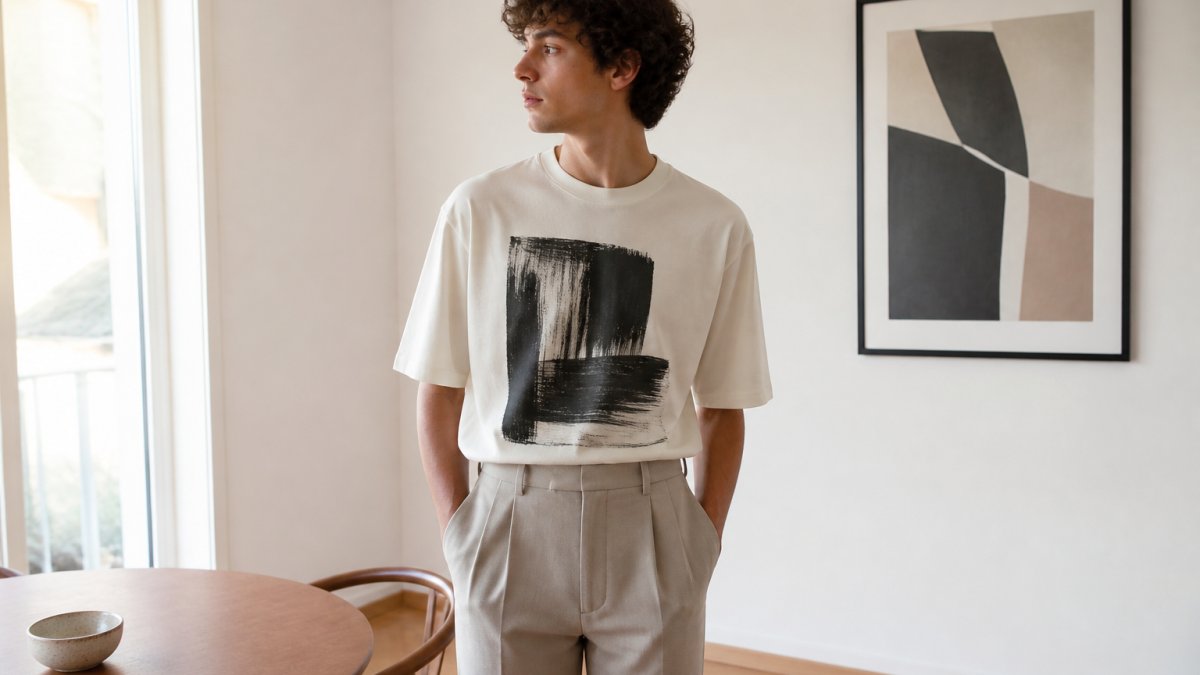
Our Abstract Art Unisex Garment-Dyed T-shirt is a good first pick: 100% ring-spun cotton, relaxed fit, double-needle stitching, and a no-side-seam design that keeps its shape.

For something more playful, the Kelp Mirror Back Unisex Garment-Dyed T-shirt brings an undulating turquoise kelp design into the mix, same soft garment-dyed cotton, same relaxed fit.
Abstract Art Unisex Garment-Dyed T-shirt →

A common mistake is pairing a loud tee with loud bottoms. Keep the bottom plain and let the shirt speak.
Styling Statement Pieces With Neutral Basics
Styling statement pieces gets easy with one formula: let the art lead and keep everything else quiet.
Three Outfit Formulas That Work Every Time
- The Simple Base: One artistic tee, plain dark trousers, clean sneakers. Works for errands, coffee, and casual Fridays.
- The Layered Look: A graphic tee under a plain cardigan or blazer, with jeans. Adds polish without hiding the art.
- The Cozy Statement: An artistic hoodie with plain joggers or jeans. Great for weekends and travel.
For cooler days, our Hummingbird Unisex College Hoodie is an easy layer: cotton-poly blend, loose fit, kangaroo pocket, true to size. The Plumeria Unisex College Hoodie offers the same cozy fit with a different design.

A statement piece doesn't need a bold color to stand out. A single strong image on a neutral garment is enough.
Art Beyond Printed Clothing: Scarves, Accessories, and Home Pieces
Prints on tees are the obvious entry point. The bigger opportunity is treating art as a category of detail you can deploy anywhere on the body. Wearable art shows up in five places, each behaving differently against a minimalist base.
The Five Carriers of Wearable Art
- Surface design, screen prints, block prints, hand-painted panels, and garment-dyed washes. This is the loudest and most literal form. It lives on tees, hoodies, and overshirts.
- Woven or knitted motifs, jacquard patterns, intarsia knits, and embroidered details. These read as texture more than image, so they stay quiet even when the pattern is complex.
- Handmade and altered details, visible mending, sashiko stitching, patches, and custom embroidery. Each piece becomes one of one, which is the strongest possible answer to "how do I keep a minimalist wardrobe from looking like everyone else's."
- Accessories as art, printed silk scarves, artful earrings, enamel pins, and structured bags with graphic hardware. These are the lowest-commitment way to test a bold motif because you can remove them in one motion.
- Home pieces, framed prints, ceramics, and textiles that carry the same visual language as your clothing. This is where the wardrobe and the room start to rhyme.
How to Choose Which Carrier Fits Your Wardrobe
Run each candidate through this filter before you buy:
- Frequency test: Will you wear it at least once a week? If not, it's decor, not wardrobe.
- Removal test: Can you take it off in under five seconds? Accessories pass; a printed jacket does not. Use this to decide how bold you can afford to go.
- Repeat test: Can you name three existing pieces it pairs with? If you can't, it will sit unworn.
Outfit Formulas That Use Non-Printed Art
- The Quiet Texture: A plain oxford shirt, dark straight-leg trousers, and a jacquard-knit cardigan. The pattern is the only visual event.
- The One-Accessory Rule: Neutral tee, neutral jeans, and a single printed silk scarf knotted at the neck or tied to a bag handle. Everything else stays flat.
- The Visible Mend: A plain crewneck with a single sashiko-repaired elbow or a small embroidered patch. It reads as intentional, not worn out.
Why This Beats Buying More Printed Tees
Printed tees are a single-note solution: once you have three, a fourth just adds volume. Home pieces let you rotate the same art language across many outfits without buying a new garment each time, fewer pieces, more ways to configure them.
Sourcing, Care, and Longevity of Artistic Garments
Artistic garments last longer when you buy well and wash with care.
When you shop, look for:
- Clear fabric details, like cotton weight and blend
- Honest sizing notes so the fit is right the first time
- A maker who explains where the designs come from
Care basics that protect your pieces:
- Wash inside out in cold water
- Skip the dryer when you can
- Avoid harsh bleach and hot irons on the print
The American Cleaning Institute's fabric care guidance recommends following a garment's care label closely, since fabric type and finish affect how it should be washed.
A common mistake is tossing graphic tees in a hot dryer. Heat is hard on prints and cotton alike. Cold wash and air dry keeps the art crisp.
Conclusion: Build a Wardrobe That Feels Like You
Building a wardrobe that feels like you takes a calm base and a few pieces with real character. Start with your core, add art on purpose, and let one strong piece lead each look.
At MobiusLDG, we make art-inspired clothing and accessories that fit right into a simple wardrobe. Our pieces help you express your personal style, with unique designs you won't see everywhere.
Frequently Asked Questions
How do you style artistic clothing with minimalist basics?
Start with a neutral base like straight-leg trousers, a plain skirt, or dark denim, then add one artistic piece as the focal point. A relaxed-fit graphic tee in a muted color pairs well with tailored bottoms because the contrast in texture keeps the outfit interesting without clutter. Keep accessories minimal so the artwork stays the hero, and repeat one color from the print in your shoes or bag to tie the look together.
How can you add color to a minimalist wardrobe without losing the clean look?
Pick one or two accent colors and use them in small, repeated doses. A scarf, a shirt, or a pair of colored earrings can carry a whole outfit without overwhelming it. Anchor the look with neutral colors like black, cream, gray, or navy, then let the accent color appear once or twice. This keeps your minimalist wardrobe cohesive while still feeling personal.
How do you choose statement pieces for a capsule wardrobe?
Look for pieces that work with at least three existing items in your closet. A statement piece should fit your color palette, match the formality of your daily life, and feel comfortable enough to wear weekly. Artistic graphic tees and handcrafted accessories are good starting points because they layer easily over basics. If a piece only works with one outfit, it is not earning its place in a minimalist capsule wardrobe.
What are some ways to put art on clothes beyond prints?
Beyond printed tees, you can incorporate art through dye techniques like garment-dyeing, which gives each piece a slightly different finish. Accessories like handbags also count. The goal is to let one artistic element stand out while the rest of the outfit stays simple and functional.
A minimalist wardrobe doesn't mean a boring one. The hard part is finding art that fits your palette, your frame, and your life, not just a trend. MobiusLDG can help with a curated collection of art-inspired tees, hoodies, and accessories made for people who want their clothes to say something. Explore our unique designs, check the fabric and fit details on each product page, and subscribe to our emails so you never miss a new piece.