

Table of Contents
- Start With a Minimalist Base Layer
- How to Style Graphic Tees Modestly
- Modest Layering Techniques That Showcase Art
- Mastering Proportions With Wide-Leg Trousers and Maxi Skirts
- Color and Texture: Balancing Bold Prints With Neutral Palettes
- Artistic Graphic Tees for Sale 2026: What to Look For
- Common Mistakes That Undermine Artistic Modest Outfits
- Frequently Asked Questions
Last Updated: September 25, 2026
Start With a Minimalist Base Layer
The fastest way to style artistic clothes for conservative dressers is a plain, well-fitted base: a neutral long-sleeve tee, fine-knit turtleneck, or button-down.
- Start with a solid neutral base in black, cream, gray, or navy
- Choose one art piece as the focal point
- Keep everything else plain and fitted
- Match your base fabric weight to the season
How to Style Graphic Tees Modestly
Learning how to style graphic tees modestly comes down to three moves, tuck, knot, and belt, each changing the shirt's shape without hiding the design. A graphic tee is the easiest entry point into artistic dressing; just control the fit so it flatters your shape while keeping coverage intact.
Tuck, Knot, and Belt for Shape
A full tuck works best with high-waisted trousers or a long skirt, defining your waist and lengthening your legs.
Modest Layering Techniques That Showcase Art
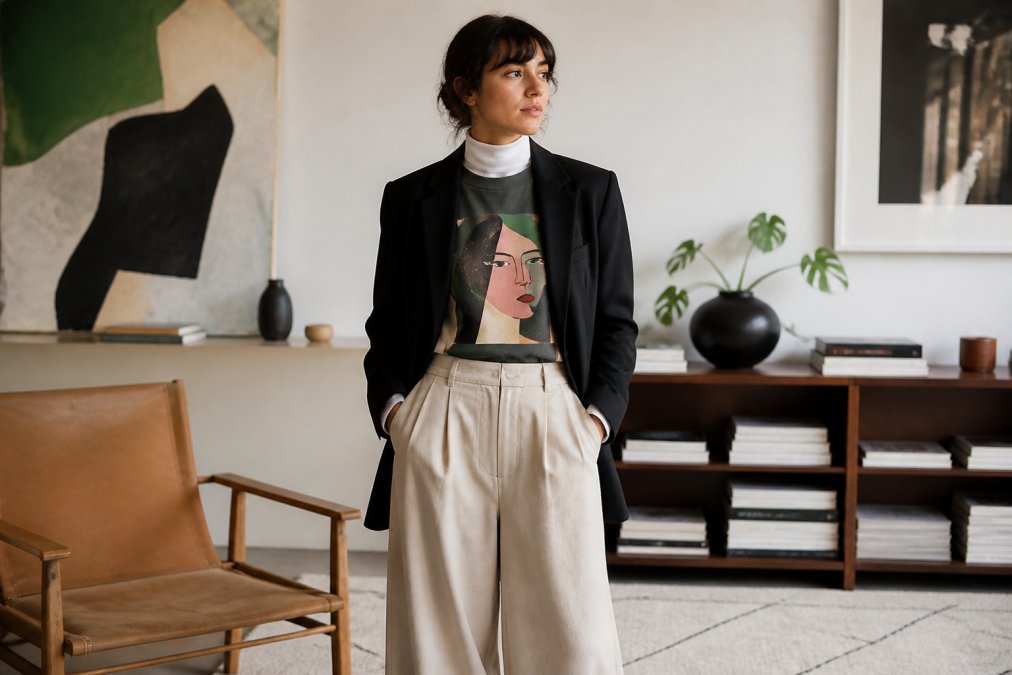
The best modest layering techniques put the artwork where people look first: chest, shoulders, and back. Everything else stays simple.
The Three-Piece Rule for Coverage and Contrast
The three-piece rule means every outfit has a base, a middle, and an outer layer, each doing a different job.
| Layer | Job | Example |
|---|---|---|
| Base | Coverage and comfort | Fine-knit turtleneck or long-sleeve tee |
| Middle | Shows the art | Graphic sweatshirt or printed top |
| Outer | Structure and polish | Blazer, long cardigan, or open overshirt |
Mastering Proportions With Wide-Leg Trousers and Maxi Skirts
Wide-leg trousers and maxi skirts are the two most reliable bottoms for artistic modest outfits, both give full coverage and balance a bulky or printed top. But the usual "pick one half to be fitted" advice falls apart when your height or build doesn't match the standard model, so this section covers proportions and how to adjust them.
The Baseline Rules
Proportion is the part most people get wrong: a loose top over a loose bottom swallows your shape. Pick one half fitted, the other relaxed.
- Fitted top plus wide-leg trousers equals a clean, balanced line
- Loose graphic top plus a straight or A-line maxi skirt equals flow and movement
- Cropped outer layer plus high-waisted bottoms equals a longer leg line
Adjusting Proportions for Petite Frames
On a petite frame, volume eats height fast, keep the vertical line unbroken:
- Choose wide-leg trousers with a high rise and a full-length hem that grazes the top of your shoe. Cropped wide-legs chop the leg line.
- Pair a maxi skirt with a fitted or tucked base layer and keep the skirt's waistband at your natural waist, not your hips.
- Keep outer layers hip-length or shorter when the bottom is voluminous. A long cardigan over a maxi skirt on a petite frame reads as one long column with no shape.
- Use a monochrome column, base, bottom, and shoes in the same value, to add visual height without heels.
Adjusting Proportions for Tall Frames
Tall frames carry volume but look stretched if everything is long and narrow:
- Wide-leg trousers with a mid or low rise and a cropped or tucked top break up the vertical and add interest.
- A maxi skirt works best with a defined waist, a belt, a tucked base, or a structured middle layer.
- Long outer layers (duster cardigans, longline blazers) are an advantage here; they add horizontal break points that taller frames need.
- Mix in horizontal textures, wide ribbing, horizontal quilting, color-blocked panels, to add width where the frame is narrow.
Adjusting Proportions for Curvy and Plus Frames
Let the art piece lead while keeping the silhouette clean:
- Choose wide-leg trousers in a fabric with weight and drape, ponte, heavy crepe, or wool blend. Thin cotton wide-legs cling and show every line.
- A maxi skirt in an A-line or bias cut skims rather than clings and moves with you.
- Keep the art piece on the upper body where it draws the eye up, and keep the bottom in a solid, darker value.
- Avoid layering a chunky knit under a structured blazer; the combination adds bulk at the waist. Choose a fine-gauge base instead.
Adjusting Proportions for Straight and Athletic Frames
Straight frames benefit from added curve and break points:
- A belted middle layer over a graphic top creates a waist where the frame is straight.
- Pleated wide-leg trousers add volume at the hip and create a curve the frame doesn't have naturally.
- A full or gathered maxi skirt adds shape at the bottom and balances a broader shoulder.
- Use texture and print to add visual weight where you want it; a printed middle layer over a plain bottom draws the eye to the torso.
The Universal Check
Whatever your frame, stand sideways in a full-length mirror before you leave. If you can trace a clear silhouette, head, shoulders, waist, hem, the proportions work. If it's one continuous blob, adjust one layer: tuck, belt, or swap a loose piece for a fitted one. Maxi dresses and skirts are especially forgiving: a long skirt with a simple base layer and one art piece on top reads as effortless elegance rather than costume.
Eye of Horus Unisex Heavy Blend™ Hooded →
Color and Texture: Balancing Bold Prints With Neutral Palettes
Neutral palettes are the safest home for bold prints, but the real rule is contrast: one loud element, everything else quiet. Understanding how contrast works separates a polished artistic modest outfit from a chaotic one.
Read the Print Before You Build Around It
Every art piece has three measurable qualities to match against the rest of your outfit:
- Value, how light or dark the print reads from a distance. A high-contrast print (black and white, deep navy and cream) needs low-contrast supporting pieces. A low-contrast print (muted earth tones, soft pastels) can handle a stronger supporting color.
- Saturation, how pure or muted the colors are. Saturated prints (true red, cobalt, emerald) pair best with desaturated neutrals. Muted prints can sit next to a single saturated accent without competing.
- Undertone, whether the print leans warm (rust, mustard, olive) or cool (slate, plum, teal). Match your neutrals to the undertone. Warm prints look muddy against cool grays; cool prints look washed out against warm creams.
Concrete Fabric Pairings That Work
Texture is the second lever: mixing textures adds depth flat color can't and makes a modest layered outfit look intentional rather than bulky. These pairings hold up across seasons:
- Smooth cotton jersey against chunky wool, the contrast in surface keeps a plain base from reading flat under a printed middle layer.
- Matte linen against a low-sheen cupro or Tencel, the slight luster on one piece catches light and draws the eye to the art, not the volume.
- Ribbed knit against flat twill, the vertical lines of ribbing slim the torso while twill holds a structured line on the bottom.
- Brushed flannel against fine-gauge merino, both are soft, but the nap difference creates a subtle depth that photographs well.
- Quilted or matelassé outerwear against a plain base, the quilting adds architectural texture without adding a print.
How Many Colors and Textures?
For a minimalist look, stick to two textures and two colors, one neutral plus the print. For a maximalist look, layer three or more textures, but keep the color family tight. A useful rule: if you can't name the lead color in one word, you have too many.
Artistic Graphic Tees for Sale 2026: What to Look For
Shopping for artistic graphic tees for sale in 2026 means checking three things: print method, fabric weight, and design originality. These determine whether a piece lasts or fades after a few washes.
Use this checklist before you buy:
- Print method is DTG or screen print, not a heat transfer
- Fabric is at least a medium-weight cotton blend
- Design is original, not a knockoff of a big brand
- Sizing runs true, with a size chart you can trust
- Care instructions are clear and realistic
Common Mistakes That Undermine Artistic Modest Outfits
The biggest mistake is treating modesty and art as opposites. Modesty is coverage and fit; art is color, print, and texture. You can have both.
Here are the errors we see most often:
- Too many focal points. One art piece per outfit. Two competing prints cancel each other out.
- Ignoring fabric weight. A thin, clingy top undermines coverage no matter how you layer it.
- Skipping the base layer. Without a plain base, bold prints sit directly against the skin and look unfinished.
- Buying oversized everything. Loose on loose hides your shape. Fit one half of the outfit.
- Chasing every trend. Trend-conscious dressing is fine, but only if the piece fits your existing wardrobe.
Frequently Asked Questions
What is the 3-3-3 rule for clothes?
The 3-3-3 rule is a packing and styling guideline: choose three tops, three bottoms, and three pairs of shoes that all work together. For conservative dressers styling artistic clothes, this means picking pieces with cohesive colors and textures so you can mix and match without clashing. It simplifies building a capsule wardrobe that still lets you rotate bold graphic pieces. Start by selecting a neutral base, then add one artistic item per outfit.
How can I incorporate artistic prints into a modest wardrobe?
Start with a modest silhouette in a solid neutral color, then add one artistic print piece, such as a graphic hoodie or a printed scarf. Keep the rest of the outfit simple so the art stands out. For coverage, choose long sleeves and high necklines on the printed item itself. If the print is on a t-shirt, layer it under a cardigan or blazer. This balances visual interest with modesty standards and keeps the focus on the artwork.
Can artistic clothing be professional and conservative?
Yes. Choose artistic pieces with subdued colors or abstract patterns rather than loud graphics. Pair a printed blouse with tailored trousers and a blazer for an office-appropriate look. Keep hemlines at or below the knee and necklines high. Fabrics like linen, wool, or cotton twill in dark or neutral tones help maintain a polished appearance. The key is letting one artistic element shine while the rest of the outfit stays classic and covered.
What are the best layering techniques for conservative fashion?
Use the three-piece rule: a base layer (turtleneck or long-sleeve tee), a mid-layer (graphic sweatshirt or artistic top), and an outer layer (blazer, cardigan, or duster). This provides coverage and lets you adjust for temperature. Choose fabrics with different weights, like a lightweight cotton tee under a medium-heavy hoodie, to avoid bulk. For modesty, ensure each layer covers the shoulders and chest. This method also adds visual texture to your outfit.