

Table of Contents
- Start With the Seller: How to Tell If an Online Art Store Is Legit
- Run a Reverse-Image and Reproductions Check on the Artwork
- Read the Certificate of Authenticity for Artwork Before You Buy
- Trace Provenance and Ownership History
- 12 Questions to Ask an Art Seller Before Paying
- Online Art Shopping Scam Red Flags to Walk Away From
- Secure Payment, Shipping, and Damage Claims
- Conclusion
- Frequently Asked Questions
Last Updated: October 17, 2026
Start With the Seller: How to Tell If an Online Art Store Is Legit
Learning how to verify authenticity of online art shops starts with the seller, not the artwork. At MobiusLDG, we know how much trust a buyer hands over at checkout.
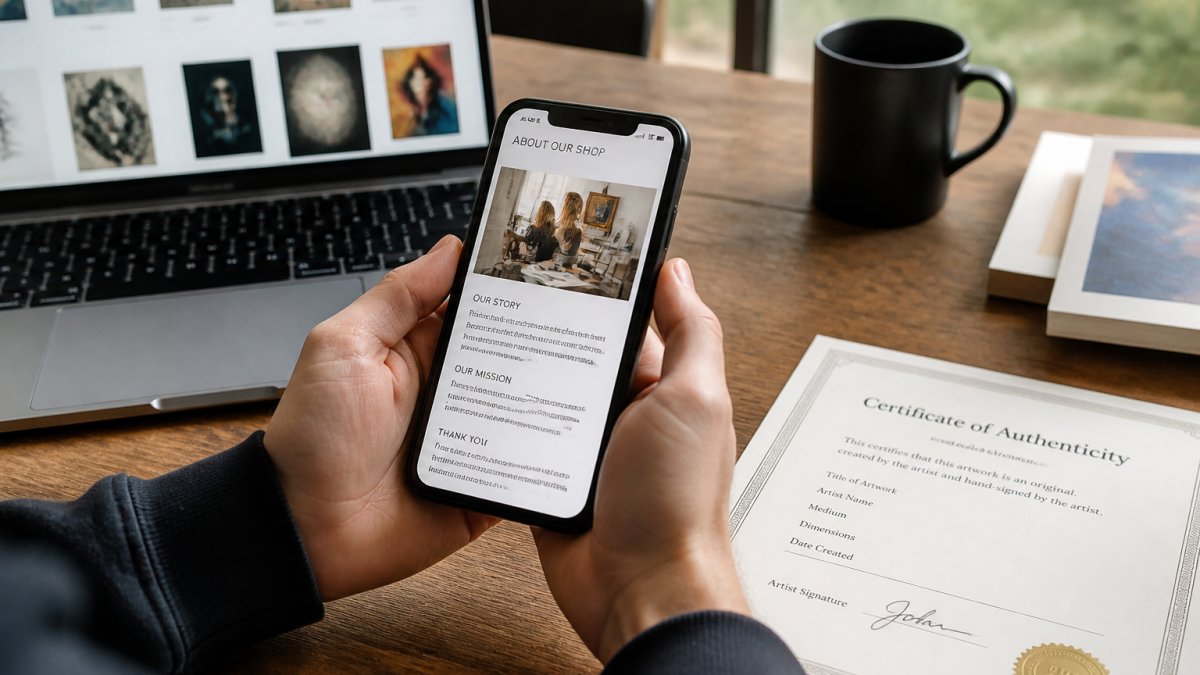
Step 1: Confirm the Business Identity and Physical Address
A real online art shop will tell you who runs it. Look for a company name, a physical address, and a working phone number or email, the fastest way to spot a store that only exists as a checkout page.
Work through these checks in order:
- Legal name and entity type. The footer, About page, and checkout receipt should name the same business, for example, "Example Gallery LLC", not a rotating set of personal names. Mismatches with the payment descriptor are a common fraud pattern.
- State business registry. Search the business name in your state's Secretary of State business search. Confirm the entity is active and that the registered agent or principal address matches what the site claims. A shop that cannot be found in any state registry is a warning.
- Physical address. Put the address into a maps tool and switch to street view. Does a gallery, studio, or warehouse actually appear? A residential mailbox or vacant lot behind a "gallery" claim is a red flag. By-appointment-only is normal, but the address should still resolve to a real commercial space.
- Contact channels. Call the listed phone number during business hours and email a specific question about a specific piece. A shop that answers only through a chat widget, or replies with copy-paste text that ignores your question, is hiding something.
The Federal Trade Commission's online shopping guidance also explains how to spot a seller who hides basic contact details. If the shop lists no address and no owner, treat that as a warning.
Step 2: Review Policies, Contact Channels, and Social Proof
Legit stores publish clear return, shipping, and refund policies. Read them before you buy, a shop that hides its return policy in fine print, or has none, will be hard to deal with later.
Check three things specifically:
- Return window and who pays return shipping. A stated window (for example, 14 or 30 days) with a named party responsible for return freight is a good sign. "Returns accepted" with no terms is not.
- Refund method and timeline. Reputable shops refund to the original payment method within a stated number of business days. A shop that offers only store credit, or that reserves the right to substitute, is shifting risk to you.
- Damage and loss terms. The policy should say who insures the shipment and how a claim is filed. If shipping insurance is not mentioned, ask in writing before checkout.
Then check how the store talks to customers:
- Does it reply to comments and emails?
- Are reviews specific, or all five stars with no detail?
- Do the same photos appear on many unrelated sites?
A shop with real customers shows real conversations. A shop with none is a gamble.
Step 3: Verify the Claimed Gallery or Studio Exists
This is the step most buyers skip, and where fake shops fall apart. If the seller claims a gallery, studio, or exhibition history, verify it independently:
- Search the gallery name plus the city in a maps tool and confirm a real storefront with photos and hours.
- Check whether the gallery appears in local arts listings, press coverage, or artist bios on other sites.
- If the shop claims the artist is represented by a named gallery, contact that gallery directly and ask whether the representation is current.
A shop that passes all three steps, registry, policies, and a verifiable physical presence, has earned a closer look at the artwork itself. A shop that fails any one of them should be treated as a pass until it provides documentation.
Run a Reverse-Image and Reproductions Check on the Artwork
The fastest way to catch a fake listing is a reverse-image search. Save the product photo and run it through Google Images or TinEye.
Next, look closely at the listing itself:
- Is the piece sold as an original, a print, or an open edition?
- Does the shop state the edition number and size?
- Are the photos high-resolution and consistent from several angles?
A genuine seller shows detailed, high-resolution images of the actual item; one blurry stock photo is a hiding signal. If the artwork looks familiar, compare it to the artist's known works, reproductions sold as originals are one of the most common forms of art fraud.
Read the Certificate of Authenticity for Artwork Before You Buy
A certificate of authenticity for artwork names the artist, title, medium, and date, and should carry a reference number and, ideally, a signature or stamp. It is useful proof but not a guarantee on its own, anyone can print a certificate.
Here is what a valid COA should include:
| Field | What to Check |
|---|---|
| Artist name | Matches the listing and signature |
| Title and medium | Consistent across all documents |
| Edition or unique ID | Numbered and traceable |
| Issuer | Gallery, publisher, or artist, named clearly |
| Signature or stamp | Present and verifiable |
Trace Provenance and Ownership History
Provenance is the documented ownership history of an artwork, from studio to current seller. Ask for it in writing. A real chain includes receipts, gallery or auction records, or prior certificates.
Match the story against the paper trail. If the seller says the work came from an estate sale, ask which one. If they name a gallery, check that the gallery exists.
12 Questions to Ask an Art Seller Before Paying
Direct questions separate real sellers from copycats. Ask these before you send money and keep the answers in writing. Each question is paired with what a strong answer looks like and what should make you pause. Score each answer green (specific and verifiable), yellow (vague but plausible), or red (evasive, contradictory, or refused). Two or more reds means stop and seek independent review before paying.
-
Who is the artist, and where can I find their catalogue raisonné?
- Green: A named artist with a published catalogue raisonné or a documented body of work you can cross-check.
- Red: The seller cannot name the artist's other works or points only to the shop's own pages.
-
Is this an original, a print, or an edition, and what is the edition number?
- Green: A clear category (original, limited edition, open edition) with an edition size and the specific number, e.g., "12 of 50."
- Red: "Original print" with no edition size, or the edition number changes when you ask again.
-
Can you send high-resolution images of the signature and the back of the piece?
- Green: Close, sharp photos of the signature, verso, labels, and any stamps, plus a scale reference.
- Red: Only the same listing photo, or images too low-resolution to inspect.
-
What is the full provenance and ownership history?
- Green: A dated chain, studio, gallery, auction, private collection, with at least some documents you can verify.
- Red: "From a private collection" with no dates, names, or paperwork.
-
Who issued the certificate of authenticity, and can I contact them?
- Green: A named gallery, publisher, or artist estate with contact details you can independently verify.
- Red: A COA issued only by the seller, with no third party to call.
-
What is your exact return policy, including who pays return shipping?
- Green: A stated window, a named party responsible for return freight, and a refund timeline.
- Red: "No returns on art" or terms that change once you ask.
-
How will the piece be packed, shipped, and insured?
- Green: Named carrier, declared insurance value, and a described packing method (crate, corner protectors, glassine).
- Red: No insurance, no carrier named, or "we are not responsible after it ships."
-
Which payment methods do you accept, and is buyer protection included?
- Green: Credit card or an established platform with dispute rights, processed through the shop's own checkout.
- Red: Wire transfer, gift card, or cryptocurrency only, or a request to pay a personal account.
-
Can you confirm your business address and registration?
- Green: A state-registered entity name and an address that resolves to a real commercial space.
- Red: A P.O. box only, or a refusal to name the legal entity.
-
Do you have comparable works or references from past buyers?
- Green: Specific past sales or references you can contact, with dates.
- Red: Generic testimonials with no names, dates, or verifiable buyers.
-
What condition is the piece in, and are there any repairs or restorations?
- Green: A written condition report noting any repairs, with photos of the affected areas.
- Red: "Excellent condition" with no detail, or repairs disclosed only after you ask twice.
-
What is the reference number for this sale?
- Green: A unique reference number that matches the invoice, the COA, and any shipping documents.
- Red: No reference number, or a number that does not match across documents.
Online Art Shopping Scam Red Flags to Walk Away From
Some signals should end the conversation outright. Walk away if the seller:
- Pushes you to pay by wire transfer, gift card, or cryptocurrency
- Offers a steep discount for paying outside the shop's checkout
- Refuses to share more photos or details about the artist
Payment choice matters most. Credit cards and established payment platforms offer dispute options. Wire transfers and gift cards usually do not. The Consumer Financial Protection Bureau's guidance on disputing charges explains how buyer protections work when a purchase goes wrong.
Secure Payment, Shipping, and Damage Claims
Pay through the shop's own secure checkout or a platform with buyer protection. Never move payment to a personal account, even if asked, that single step removes most of your recourse.
Before checkout, confirm the shipping terms:
- Who insures the package, and for how much?
- What happens if the piece arrives damaged?
- What is the deadline for filing a damage claim?
Photograph the package before you open it, and keep the box until you have inspected the work. If damage occurs, file the claim in writing right away. A clear paper trail makes the difference between a refund and a loss.
Conclusion
Verifying an online art shop takes a little time, but it protects both your money and your trust. Check the seller, run an image search, read the certificate, and trace the provenance before you pay. When you shop with MobiusLDG, you get a curated collection of unique T-shirts, prints, and accessories. Subscribe to our emails to see new pieces first and buy with confidence.
Frequently Asked Questions
How can I tell if an online art shop is legitimate?
Check the business identity first: a real company name, a physical address you can verify, and a working phone number. Read the return policy and shipping terms in full, and look for reviews on independent platforms rather than only on the shop's own site. A legitimate online art shop will answer specific questions about materials, edition sizes, and where the work ships from. If the seller avoids details or pushes you toward a payment method with no buyer protection, treat that as a warning sign.
What should a certificate of authenticity for artwork include?
A useful certificate of authenticity for artwork names the artist, the title, the medium, the dimensions, and the year of creation. For prints, it should state the edition size and the edition number. It should also include a reference number or unique identifier, the date of sale, and the signature of the artist or the authorized publisher. A COA is supporting documentation, not proof on its own, so compare its details against the artwork and the seller's listing before you rely on it.
What are the red flags of a fake online art store?
Common online art shopping scam red flags include prices far below market value for a named artist, stock photos that appear on multiple sites, no physical address, and policies that block returns. Be cautious when a seller asks for payment by wire transfer, gift card, or cryptocurrency, since those offer little dispute protection. Pressure to buy immediately, missing contact information, and a website with no reviews outside its own pages are also signals to slow down and verify before paying.
How can I check whether an artwork is an original or a reproduction?
Ask the seller directly whether the piece is an original, a limited edition print, or an open edition reproduction, and get the answer in writing. Request high-resolution images of the front, back, signature, and any edition number. Compare those images against the artist's known works and any catalogue raisonné. For higher-value pieces, an independent specialist can inspect the work in person. A physical inspection remains the most reliable way to confirm whether a piece is an original or a reproduction.