

Table of Contents
- Why Graphic T-Shirt Prints Crack
- How to Prevent T-Shirt Prints from Cracking
- How to Wash Graphic Tees Without Damaging Prints
- How to Dry Graphic T-Shirts Safely
- How to Fix Cracked T-Shirt Prints
- Screen-Printed vs. Direct-to-Garment Durability
- Environmental Factors That Speed Degradation
- Frequently Asked Questions
Last Updated: October 7, 2026
Why Graphic T-Shirt Prints Crack
Graphic t-shirt prints crack for one simple reason: the ink layer loses flexibility. When you stretch a shirt, the fabric moves but the print doesn't, and over time this mismatch causes the ink to splinter and peel away from the fibers.

Most people blame cheap printing, but the real culprit is usually what happens after the shirt leaves the factory. How you cure, wash, dry, and wear it determines whether it lasts six months or six years.
The answer involves three factors: curing temperature, fabric elasticity, and mechanical stress from washing and wearing.
The good news: cracking is preventable, and existing damage is sometimes fixable. This guide covers why prints crack, how to prevent it, and what to do when damage is done.
Under-Curing vs. Over-Curing Plastisol Ink
Under-cured ink is the most common cause of premature cracking. Plastisol ink requires heat to polymerize; if the temperature is too low or dwell time too short, the ink stays soft and brittle, so it breaks instead of flexing when the shirt stretches.
Over-curing is less common but equally destructive. Excessive heat degrades the ink's polymer chains, making the material rigid and inelastic, and can thermally degrade the fabric itself. The print then cracks when the shirt moves.
The sweet spot depends on your ink and equipment. Most screen-printed plastisol inks cure best at 300°F to 330°F, with a heat press needing 15-20 seconds of dwell time. A curing conveyor requires precise speed calibration to match the ink's polymerization window.
Check your curing setup before wearing a new print. If the temperature is off by just 20 degrees, the ink won't polymerize correctly. A heat gun or infrared thermometer verifies your press or conveyor hits the target temperature, preventing most cracking issues.
Ink Layer Thickness and Print Flexibility
Thicker ink deposits look bolder but crack more easily. A thick ink layer has more internal stress: when the fabric stretches, the outer edges of the print move differently than the inner edges, creating tension within the ink layer itself.
Thin, even ink deposits flex with the fabric as one unit. Consistency is key: if your mesh count is too coarse or ink viscosity too thick, you'll deposit uneven layers, and thick spots crack while thin spots flex.
Direct-to-garment (DTG) printing avoids this by depositing ink in microscopically thin layers, while screen printing builds up visible thickness. If screen printing, use a higher mesh count (around 110-160 mesh); lower counts (around 60-85 mesh) create thick, rigid prints that crack easily.
Puff additives make prints thicker and puffier, but increase cracking risk because the puffed material is more rigid than regular plastisol. If you use puff ink, cure it carefully and avoid tight, fitted garments where mechanical stress is highest.
Fabric Elasticity and Mechanical Stress
Not all fabrics are equal. Cotton is naturally elastic, polyester blends more so, and tight weaves flex less than loose ones. The more your fabric stretches, the more stress your print endures.
A 100% cotton jersey shirt has good elasticity and its fibers move smoothly, while a stiff cotton canvas doesn't flex as much, so prints on canvas crack faster because the fabric itself resists movement.
Fiber content matters too. Pure cotton stretches more than cotton-polyester blends, and spandex adds elasticity but can interact poorly with certain inks. Check fabric composition before printing; for stiff or low-elasticity materials, use thinner ink deposits and lower curing temperatures.
Mechanical stress comes from wearing and washing: every time you put on a shirt you stretch the fabric, and every wash cycle agitates the fibers. Repeated stretching and compression fatigues the ink layer until it finally cracks.
How to Prevent T-Shirt Prints from Cracking
Prevention is easier than repair. Most cracking stems from one or two fixable mistakes in printing or care; address them and your prints will last years instead of months.
Perform a Stretch Test Before Wearing
A stretch test tells you if a print will survive daily wear. It takes 30 seconds, requires no equipment, and should be done before you first wear a new graphic tee.
Lay the shirt flat, gently grab the fabric on both sides of the print, and pull away from the print in all directions. The fabric and print should stretch together. If the print cracks, peels, or shows white stress lines, the cure was incomplete.
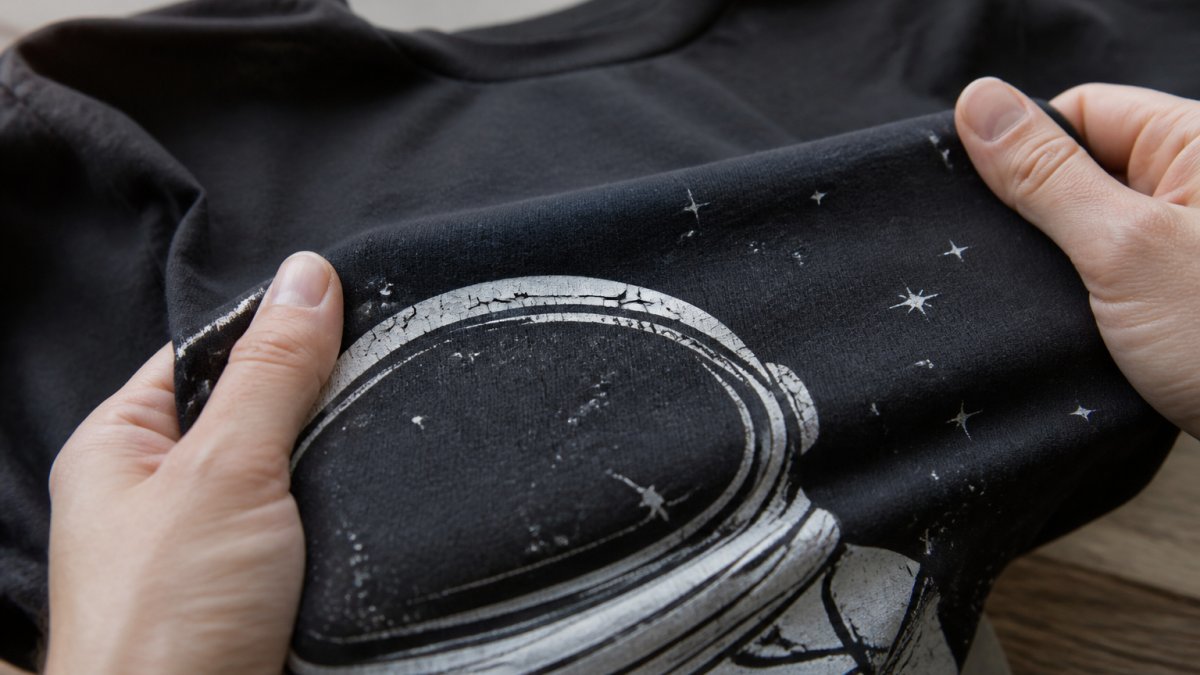
A good print flexes without cracking; a bad one shows white lines or peels at the edges. If your stretch test fails, don't wear the shirt, the print will crack within a few wears anyway.
This test works for screen-printed and DTG prints, and for sublimation transfers, though sublimated prints rarely crack because the ink bonds chemically with the fabric.
Check Curing Temperature and Time
Your curing setup is probably the culprit. Most home and small business printers use heat presses, which are convenient but inconsistent: temperature varies across the platen and dwell time is easy to misjudge.
Buy a heat gun or infrared thermometer (under $20). Place it on your heat press platen, close the press, note the temperature, wait 30 seconds, and check again. If it fluctuates by more than 10 degrees, your press needs calibration or replacement.
For screen printing, curing conveyor belts are more reliable than heat presses because they maintain consistent temperature across the garment's width. For high volumes, a conveyor is worth the investment.
Document your curing settings, temperature, dwell time, and mesh count for each design, and keep a sample from each print run. After a few weeks of wear, examine the samples; if they cracked, raise your curing time or temperature by 10-15 degrees next time.
How to Wash Graphic Tees Without Damaging Prints
Washing is the second biggest threat to print durability. Hot water weakens the bond between ink and fabric. Aggressive agitation damages the print surface. Harsh detergents break down the ink's polymer structure.
Water Temperature and Wash Settings
Cold water is your friend. Wash graphic tees in cold water only. Never use warm or hot water. Cold water prevents thermal stress on the ink layer and reduces dye bleeding from the fabric.

Use the gentle or delicate cycle. This reduces agitation and mechanical stress on the print. Avoid overloading the washer. Crowded garments rub against each other, causing friction damage to the print surface.
Alebrije Dog Unisex Jersey Short Sleeve Tee →
Turn the shirt inside out before washing. This protects the print from direct contact with other garments and the washer drum. It's a simple step that adds months to print life.
Use mild detergent. Avoid bleach and oxygen-based cleaners. These break down the ink's polymer bonds. Choose a detergent designed for delicate fabrics. Woolite, Seventh Generation, and similar brands work well for graphic tees.
Wash graphic tees separately from regular clothes when possible. Zippers, buttons, and seams on other garments can snag and damage the print.
How to Dry Graphic T-Shirts Safely
Heat from the dryer causes thermal degradation of the ink and fabric. High temperatures weaken the polymer chains in plastisol ink. They also shrink the fabric, creating additional stress on the print.
Air dry graphic tees whenever possible. Hang them on a clothesline or lay them flat on a clean surface. Drying takes 4-8 hours but preserves print quality for years.

If you must use a dryer, use the lowest heat setting. Set the timer for 20-30 minutes maximum. Remove the shirt while it's still slightly damp. Finish drying on a hanger or flat surface.
Never use the high heat setting. Never overdry. Overdrying causes shrinkage and accelerates ink degradation. The few minutes you save aren't worth the damage.
How to Fix Cracked T-Shirt Prints
If the damage is already done, you have limited options. Small cracks might be repairable. Large cracks or widespread peeling usually aren't worth fixing.
When Repair Is Possible vs. When It Isn't
Small cracks (less than 1 inch) at the edges of the print might be repairable. Large cracks across the design usually aren't. If more than 20% of the print is cracked or peeling, replacement is more practical than repair.
Repair methods are limited. You can't re-cure a screen-printed design. You can't reapply ink to a DTG print. The best option is a fabric paint or ink patch. Buy fabric paint that matches your print color. Apply it carefully over the cracked area with a small brush. Let it dry completely. This creates a visible patch, but it stops the crack from spreading.
For valuable or sentimental shirts, professional repair services exist. They can re-screen the design or apply a new transfer. Cost is usually $15-30 per shirt. It's only worth it for rare or irreplaceable designs.
The practical reality: most cracked prints can't be fully restored. Prevention is far easier than repair. Focus your energy on avoiding cracks in the first place.
Screen-Printed vs. Direct-to-Garment Durability
Screen printing and DTG printing have different durability profiles. Understanding the difference helps you choose the right printing method for your needs.
Screen-printed plastisol ink sits on top of the fabric. It's visible and tactile. It lasts longer if cured correctly because the ink layer is thick and durable. Screen printing also allows puff and specialty inks that add texture and visual interest.
DTG printing uses water-based inks that absorb into the fabric. The ink bonds chemically with the fibers. DTG prints are softer and more flexible than screen prints.
For artistic designs with fine detail, DTG is superior. For bold, graphic designs with limited colors, screen printing is more durable. MobiusLDG uses DTG for our graphic tees because it preserves the intricate detail of our artists' work.
Sublimation printing uses heat to transfer dyes into synthetic fabrics. Sublimated prints are extremely durable. The dye becomes part of the fabric itself. Sublimation doesn't work on cotton or natural fibers, but on polyester it's nearly cracking-proof.
Environmental Factors That Speed Degradation
Sun exposure, humidity, and temperature fluctuations degrade prints faster than normal wear. Understanding these factors helps you protect your graphic tees long-term.
UV light breaks down the polymer bonds in ink. Prints exposed to direct sunlight fade and become brittle faster than prints stored indoors.
High humidity promotes mold growth on the fabric and weakens ink adhesion. Low humidity can cause the fabric to become brittle.
Temperature swings stress the fabric and ink. Rapid heating and cooling cause expansion and contraction. This mechanical stress accumulates over time.
Chlorine in pools and hot tubs damages both fabric and ink. If you wear a graphic tee to a pool, rinse it immediately in cold fresh water.
Salt water from the ocean also damages prints. The salt crystals abrade the ink surface. Rinse immediately in fresh water if your shirt gets exposed to salt water.
Cracked graphic t-shirt prints are frustrating, but they're preventable. The key is understanding what causes the damage: improper curing, mechanical stress, and harsh washing.
Frequently Asked Questions
Why do graphic t-shirt prints crack?
Graphic t-shirt prints crack due to a combination of factors: under-cured or over-cured plastisol ink, excessive ink layer thickness that reduces flexibility, and mechanical stress from stretching and body movement. Fabric elasticity plays a major role, when the shirt stretches but the print doesn't, the ink layer fractures. Thermal degradation from heat exposure and improper washing also accelerates cracking over time.
How do I prevent t-shirt prints from cracking?
Prevent cracking by performing a stretch test before wearing to identify weak prints early. Ensure proper curing temperature during manufacturing, plastisol ink requires specific heat exposure to achieve full polymerization. Wash inside out in cold water, avoid the dryer, and lay flat to dry. Choose garments with quality cotton fiber content and appropriate ink deposit thickness. Store prints away from direct sunlight and extreme heat.
Can you fix a cracked print on a t-shirt?
Minor surface cracks can sometimes be stabilized with fabric sealant products applied carefully to the affected area, though results vary. Deep cracks that penetrate the ink layer are difficult to repair permanently. Prevention through proper care is more effective than repair. If cracking is severe, the print is generally considered damaged beyond practical restoration.
What's the difference between screen-printed and direct-to-film durability?
Screen-printed designs with proper curing can be very durable because plastisol ink bonds well to fabric fibers. Direct-to-film (DTF) printing offers excellent color vibrancy and detail but may be more prone to cracking if the transfer film isn't properly adhered during application. Both methods require correct curing temperature and humidity control to prevent thermal degradation and premature failure.