

Table of Contents
- Start With Scale: The Best Art Size for a Small Room
- How to Hang Art in a Small Apartment
- Small Apartment Gallery Wall Ideas That Fit Tight Walls
- Art Placement Above a Sofa and Other Seating Areas
- Choosing Colors and Frames That Work With the Room
- Art for Multifunctional Rooms and Narrow Entryways
- Lighting, Glare, and Protecting Your Art
- Budgeting and Sourcing Art Without Overspending
- Frequently Asked Questions
Last Updated: October 18, 2026
Start With Scale: The Best Art Size for a Small Room
The best art size for a small room covers roughly 50 to 75 percent of the wall width above the furniture it sits over. Undersized pieces are the most common mistake in small apartments.
Scale is about proportion, not square footage. A compact home with a low sofa needs a wide, low piece. A tall narrow wall beside a door needs a vertical arrangement.
At MobiusLDG, we think of wall art as the anchor of a room's structure. Get the size right and everything else falls into place.
Two Measuring Rules That Decide the Size
Measure the wall first, then the furniture. These two rules cover most small apartment walls:
- The furniture rule: Art above a sofa or bed should span two-thirds to three-quarters of the furniture's width. A 60-inch sofa takes art 40 to 45 inches wide.
- The breathing-room rule: Leave 6 to 8 inches between the art and the furniture below it. Leave at least 12 inches between art and the ceiling or a corner.
Write both numbers down before you shop. A paper template taped to the wall beats guessing every time.
How to Hang Art in a Small Apartment
Hang art so its center sits at eye level, about 57 to 60 inches from the floor. This one rule keeps a whole gallery wall looking intentional. In a small apartment, consistent hanging height does more for a polished look than expensive frames.
Group pieces closer than feels natural. A gap of 2 to 3 inches between frames reads as one unit. Wide gaps break the visual structure and make tight walls feel cluttered.
Renter-Friendly Hanging Without Losing Your Deposit
Most leases restrict nail holes, and patching every hole before move-out is tedious. The practical answer is to match the hardware to the wall type and the weight of the piece. Work through these options from lightest to heaviest:
- Adhesive strips for prints and small canvases under about 3 pounds. Clean the wall with rubbing alcohol, press the strip for 30 seconds, and wait an hour before hanging. Most failures come from overloading the strip or mounting on textured or freshly painted walls.
- Picture-hanging hooks with small nails for medium frames. A single 20-pound hook leaves a hole smaller than a pencil eraser that a dab of spackle hides at move-out. Use two hooks spaced a few inches apart for wider frames so the piece stays level.
- A picture ledge or leaning shelf for heavier pieces and for walls you cannot drill. Lean framed art against the wall on the ledge, and use museum putty under the bottom corners to keep it from sliding. This works well above a sofa or in a hallway where you want to rotate pieces.
Wall Type and Weight Checks
Drywall holds adhesive strips and small hooks well. Plaster and brick need masonry anchors or a ceiling rail, and older plaster can crumble around a nail. Stud finders are inexpensive and worth owning before you hang anything heavier than a poster. For pieces over about 20 pounds, drive into a stud or use a toggle bolt rated for the load.
Hanging Height for Different Rooms
Eye level is the default, but the reference point shifts by room. In a living room, center art on the sofa back. In a dining area, hang it lower so it reads from a seated position, roughly 48 to 52 inches to center. In a hallway, keep the center at eye level so the piece meets you as you walk.
Small Apartment Gallery Wall Ideas That Fit Tight Walls
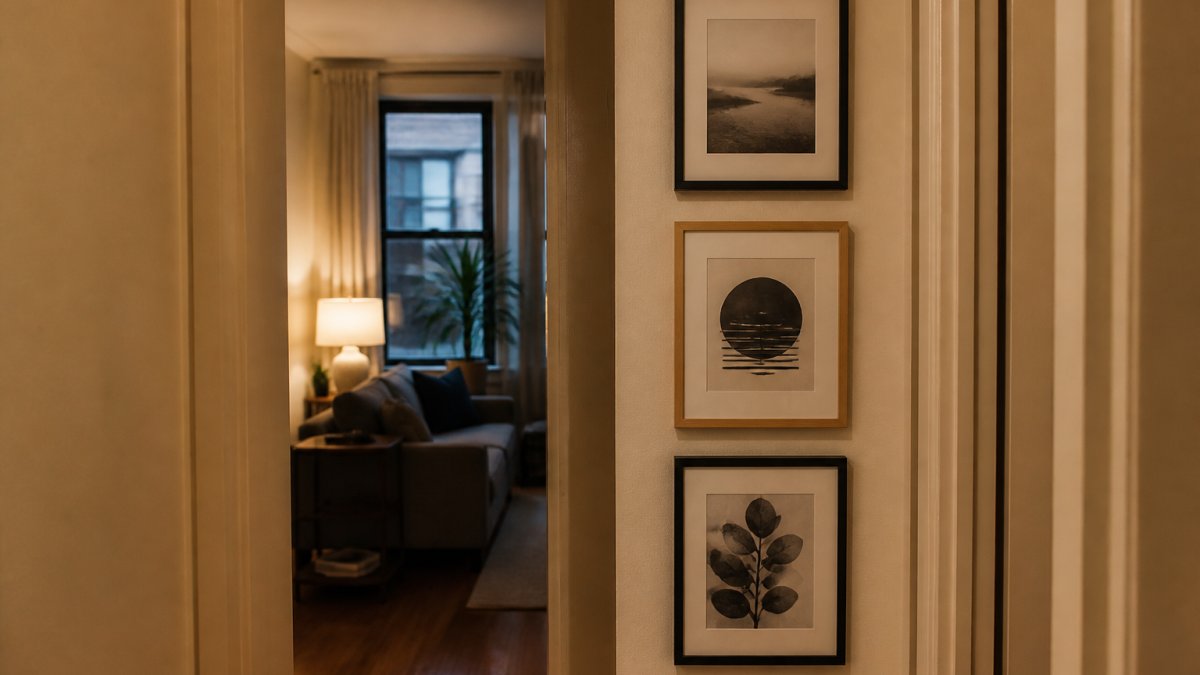
Small apartment gallery wall ideas work best when they grow vertically, not horizontally. A vertical arrangement uses height you already have and leaves floor space clear.
Start with one anchor piece, then build around it with smaller prints in the same color palette. Mix frame profiles, such as a black frame next to light wood, for a casual look.
Three layouts that fit narrow walls:
- The column: three to five pieces stacked in one vertical line
- The grid: six small prints in two rows, aligned edges
- The salon cluster: mixed sizes tight together around one statement piece
Art Placement Above a Sofa and Other Seating Areas
Art above a sofa should anchor the seating area, not float above it. Center the piece on the sofa, not on the wall, especially in an open-plan room.
For a seating area, one large statement piece often beats a cluster of small frames. A single canvas gives the eye one place to rest. In a small living room, that calm matters.
A few placement rules we follow:
- Keep art at least 6 inches above the sofa back
- Match the art's width to two-thirds of the sofa
- Skip art on every wall; one focal point per zone is enough
Choosing Colors and Frames That Work With the Room
Pull one or two colors from the room into the art, then add one contrast color. A room of neutral tones welcomes a bold print. A colorful room needs calmer art with a simple frame.
Baby World Canvas Stretched, 1.5'' →
Frame choice changes everything. A light wood frame softens a modern room. A black frame adds contrast and structure. A white mat gives any print room to breathe.
Art for Multifunctional Rooms and Narrow Entryways
In a studio apartment, one wall often serves the sofa, the bed, the desk, and the dining table at once. Art has to work from every one of those positions, and that changes how you choose it. A piece that looks right above the sofa can feel heavy over the desk or distracting from the bed.
Zone the Wall Before You Choose Art
Sketch the room on paper and mark each function: sleep, sit, eat, work. Then assign one art moment per zone rather than treating the whole wall as a single gallery. A common pattern is a larger piece over the sofa, a small print or two at the desk, and nothing over the bed if the ceiling is low. This keeps each zone visually separate without adding walls.
Pick Art That Reads From Multiple Sightlines
Art in a studio gets seen from the sofa, the bed, the desk chair, and the kitchen counter. Choose pieces with a clear focal point and a simple composition. Busy patterns and dense detail compete with screens, paperwork, and clutter, and they look chaotic from an angle. A single strong shape or a calm landscape holds up from across the room and from a few feet away.
Match Art to the Dominant View
Decide which position matters most. If you spend evenings on the sofa, the wall opposite the sofa is the primary view and deserves the anchor piece. If the bed faces a different wall, put a quieter piece there. In a studio, you cannot give every wall equal weight, so rank the views and spend your budget on the one you look at most.
Narrow Entryways
Narrow entryways call for vertical pieces. A tall, slim canvas or a stacked pair draws the eye up and makes a tight hall feel taller. Keep frames shallow so they do not crowd the walkway, and hang the center at eye level so the piece meets you as you come in.
Our Hummingbird Canvas Gallery Wraps come in vertical, horizontal, and square options, which makes fitting an awkward entryway wall simpler. The closed MDF backing keeps the profile clean against a tight wall.

Lighting, Glare, and Protecting Your Art
Glare ruins a good piece faster than a bad frame. Hang art away from direct sun and away from lamps that shine straight onto reflective glass.
Protection basics for a small apartment:
- Keep art out of humid rooms like bathrooms unless the piece is rated for it
- Avoid hanging above a radiator or heat source
- Dust canvas with a dry, soft cloth, never a wet one
- Use UV-filtering glass on valuable prints
Canvas prints handle glare better than glossy framed prints. Our Dove and Olive Branch Canvas Gallery Wraps use a textured cotton surface that softens reflections, and the listing notes they are for indoor use only.

Budgeting and Sourcing Art Without Overspending
Set a budget per wall before you browse, not per piece. A gallery wall of five small prints can cost less than one large framed original. Decide the wall's total budget and work backward.
Ways to source art without overspending:
- Buy unframed prints and frame them yourself
- Mix one investment piece with budget prints
- Check artist marketplaces and local print shops
- Choose canvas over framed glass to skip framing costs
Our Baby World Canvas Stretched print runs $28.13, which makes it an easy starting piece for a first apartment wall. It arrives hand-stretched on a pine frame and assembled in the USA from globally sourced parts.

Frequently Asked Questions
What size art works best in a small apartment?
Aim for art that covers about 60 to 75 percent of the width of the furniture below it. Above a 72-inch sofa, that means a piece roughly 43 to 54 inches wide, or a grouping that totals that width. On a narrow wall, a single vertical canvas between 16 and 24 inches wide often works better than several small prints. The goal is one confident piece rather than a scatter of tiny frames that adds visual clutter.
How high should you hang art in a small space?
Center the artwork at 57 to 60 inches from the floor, which is roughly eye level for most adults. Above furniture, leave 6 to 8 inches between the top of the sofa or console and the bottom of the frame. In a small apartment, hanging slightly lower helps low ceilings feel taller. Measure from the floor to the center point, mark it, then work out where the hanging hardware sits on the back of the frame.
Is one large piece better than a gallery wall in a small apartment?
One large piece usually wins in a compact room. A single canvas reads as a focal point and reduces visual clutter, which makes tight walls feel calmer. Gallery walls work when you have a long empty wall or want to show a collection, but keep the frames to three to five and space them 2 to 3 inches apart so the group reads as one unit. Mix a large anchor piece with two smaller ones if you want both.
How can art make a small apartment feel bigger?
Choose pieces with open space, light backgrounds, or simple compositions, and avoid dense, busy images that crowd the eye. Hang art on the wall opposite the main window so it catches daylight, and keep frames slim so the artwork itself does the work. A vertical arrangement draws the eye upward and makes ceilings feel higher. Repeating one color from the room in the art ties the space together without adding clutter.
Choosing art for a small apartment comes down to scale, placement, and restraint. Get the proportions right and a compact room feels curated, not crowded. At MobiusLDG, we create art and accessories cast from dreams, made for people who want their space to feel personal. Browse our canvas collection, pick a piece that fits your wall measurements, and subscribe to our emails for first looks at new designs.