

Table of Contents
- The Real Difference Between Curated Home Decor and Mass-Produced Pieces
- The Environmental Cost of Fast Furniture and Disposable Decor
- Benefits of Handcrafted Home Decor: Quality, Longevity, and Cost-Per-Use
- How to Curate a Home Aesthetic That Reflects Your Personal Narrative
- Buy Artistic Wall Art Online 2026: A Practical Guide to Thoughtful Selection
- The Hybrid Approach: Mixing Investment Pieces with Everyday Items
- Maintenance, Care, and Resale Value: The Full Lifecycle of Curated Decor
- Frequently Asked Questions
Last Updated: September 27, 2026
The Real Difference Between Curated Home Decor and Mass-Produced Pieces
Walk through most homes built in the last decade and you'll see the same room twice: the same geometric print above the same gray sofa. Curated home decor is chosen deliberately, over time, for how it fits a specific space and person. Mass-produced decor is inventory designed to sell to everyone at once.
The Environmental Cost of Fast Furniture and Disposable Decor
Fast furniture follows the fast-fashion playbook: low prices, short cycles, and a steady stream of new styles that make last year's purchase feel dated, decor built to be replaced rather than kept.
Benefits of Handcrafted Home Decor: Quality, Longevity, and Cost-Per-Use
Handcrafted home decor wins on cost-per-use, not sticker price. A mass-produced print may cost less today, but if it fades, warps, or gets donated within a couple of years, its cost per year of enjoyment is higher than a well-made piece that stays on the wall for decades.
Cost-per-use math works like this:
| Factor | Mass-Produced Piece | Handcrafted Piece |
|---|---|---|
| Upfront cost | Lower | Higher |
| Typical lifespan | A few years | Many years |
| Repair options | Usually none | Often repairable |
| Resale value | Minimal | Can hold value |
| Cost per year of use | Often higher | Often lower |
Why Artisan Craftsmanship Outlasts Machine-Made Production
Machine-made decor is optimized for speed and consistency; artisan craftsmanship for durability and detail. A hand-finished canvas uses a heavier substrate and solid support structure that resists sagging, while mass-market prints use thin material over a lightweight frame, which is why they ripple or bow within a few seasons.
How to Curate a Home Aesthetic That Reflects Your Personal Narrative
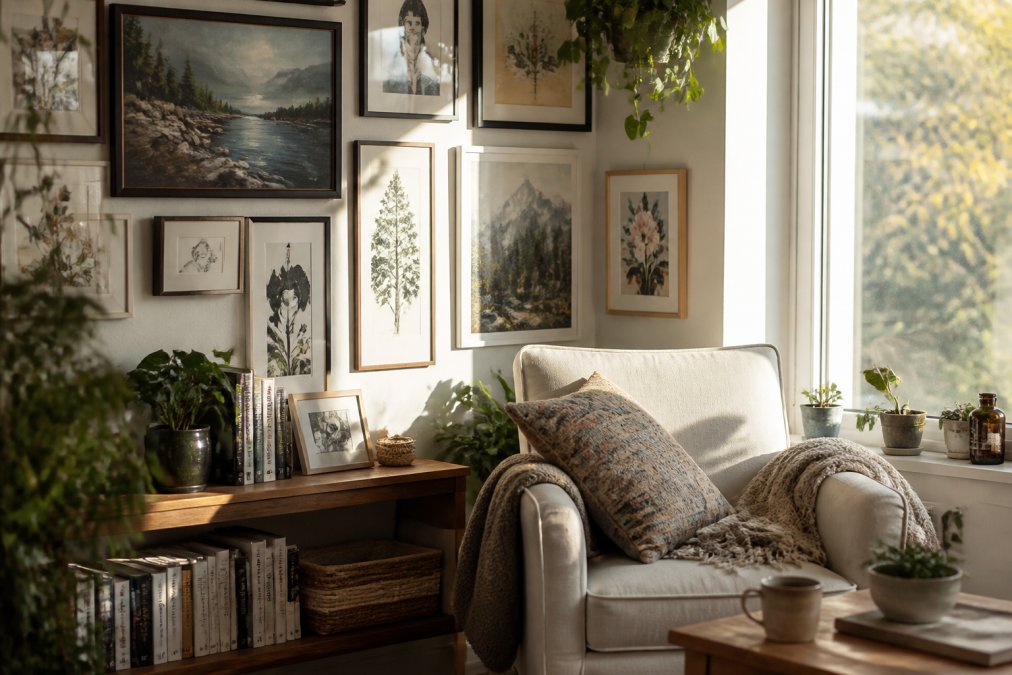
Start with what you already own and love, then build outward. A curated home aesthetic isn't a shopping list; it's an editing process. Pull the pieces that mean something, group them, and let the gaps tell you what to add next.
- Audit one room. Remove everything decorative and put back only what you'd keep if you moved tomorrow.
- Identify the throughline. Look for repeated colors, textures, or themes in what remains. Write them down as three to five words, not a mood board.
- Choose one anchor piece. A statement canvas or handcrafted object sets scale, palette, and tone for everything around it.
- Build in odd numbers. Groups of three or five read as intentional; pairs often read as accidental.
- Leave negative space. Empty wall isn't wasted wall. It's what makes the chosen pieces visible.
Where to Source Curated Pieces (and What Each Channel Is Good For)
Different channels solve different problems; knowing which is which prevents overpaying and settling:
- Artist studios and open-studio events: Best for one-of-a-kind work and direct relationships. You see the actual piece, meet the maker, and learn the material story firsthand. Trade-off: limited inventory and no returns.
- Gallery wraps and print-on-demand studios: Best for consistent material specifications across multiple sizes. You can verify substrate weight, backing, and support face before buying. Trade-off: less one-of-a-kind, more reproducible.
- Estate sales and auctions: Best for era mixing and pieces with history. Trade-off: condition varies, and you need to inspect for water damage, fading, or frame rot.
- Local makers' markets: Best for small objects, ceramics, and textiles that add texture between larger pieces. Trade-off: seasonal availability.
- Inherited and gifted pieces: Best for narrative. A piece with a story does more for a room than a piece with a receipt.
Avoiding the Cookie-Cutter Aesthetic in Your Space
The cookie-cutter aesthetic comes from buying complete looks rather than individual pieces. When every item arrived from the same collection in the same season, the room looks staged, not lived in. Staging sells a house to a stranger; your home should fit you.

The Patience Problem (and How to Make Waiting Productive)
Curated rooms are built over years, not weekends, and that timeline is the hardest part. Treat the gaps as intentional rather than unfinished: an empty wall you're saving for the right piece reads differently than one you simply haven't gotten to.
Three ways to make the waiting work:
- Keep a running list of what the room needs (scale, palette, subject) so you recognize the right piece when you see it instead of settling for something close.
- Rotate what you already own between rooms. A piece that feels stale in the living room often reads fresh in a hallway or bedroom.
- Buy the anchor first, the accents last. Accents are easy to find; anchors are not. Locking the anchor early prevents a room full of small pieces with nothing holding them together.
Buy Artistic Wall Art Online 2026: A Practical Guide to Thoughtful Selection
Buying artistic wall art online in 2026 comes down to four checks: material, construction, size, and fit with your space. Get those right and the purchase holds up; skip them and you're gambling on a photo.
Here's what to verify before checkout:
- Substrate: Look for artist-grade cotton canvas or another specified material, not a vague "premium" claim.
- Weight and thickness: A stated fabric weight, such as 400gsm, signals durability.
- Backing and support: A closed backing and a solid support face resist warping and protect the print.
- Size options: Horizontal, vertical, and square formats let you fit the piece to the wall instead of the reverse.
- Finish details: Hanging hardware included saves a second purchase and a second wait.
The Hybrid Approach: Mixing Investment Pieces with Everyday Items
The hybrid approach pairs a few investment pieces with affordable everyday items, so the room reads as curated without a full budget reset. It's the strategy most design-minded people actually use, and the one that survives real life.
Maintenance, Care, and Resale Value: The Full Lifecycle of Curated Decor
Most articles about curated decor stop at the purchase. The lifecycle after it is where curated pieces separate from mass-produced ones, and curated decor rewards maintenance in a way disposable decor never can, because it was built to be maintained.
A Concrete Care Routine for Canvas and Framed Art
Canvas and framed pieces have specific vulnerabilities, and each one has a specific fix:
- Light: Ultraviolet light fades pigments and yellows varnish. Keep pieces off walls that receive direct sun for more than an hour or two a day, or use UV-filtering glazing on framed work. Rotating pieces seasonally spreads exposure instead of concentrating it.
- Dust: Dust with a dry, soft, lint-free cloth or a soft brush. Never use household spray cleaners on canvas; moisture can wick into the substrate and stain from behind.
- Humidity: Keep interior humidity moderate and avoid hanging canvas on damp exterior walls or directly above bathrooms. Fluctuating humidity causes canvas to expand and contract, leading to sagging and rippling.
- Handling: Lift framed pieces by the frame, not the canvas or the wire. Oils from hands can leave marks that don't come out.
- Storage: If you rotate pieces, store them vertically, wrapped in acid-free tissue or a clean cotton sheet, not plastic. Plastic traps moisture and can cause mold.
What Can Actually Be Repaired (and What Can't)
Repairability is the quiet dividing line between curated and mass-produced decor:
- Canvas sag or ripple: Often correctable by a framer who can re-stretch or add support. Mass-market prints on thin substrates usually can't be re-stretched without tearing.
- Frame damage: Wood frames can be repaired, refinished, or replaced by a framer. Molded plastic or composite frames common in discount decor typically can't.
- Surface scuffs and minor marks: A conservator or framer can often address these on artist-grade canvas. On printed synthetic substrates, they usually can't.
- Hardware and hanging: Replacing wire, D-rings, or cleats is inexpensive and extends the piece's usable life. This is the single easiest repair to do yourself.
Resale Value and Circularity: The Secondary Market Mechanics
Resale value is the quieter advantage of curated decor, and it works through specific mechanics:
- Limited supply supports price. Work from recognized makers and small studios is produced in small runs, so secondary-market supply stays thin and prices hold better than for mass-produced items that flood the market the moment a trend passes.
- Specific demand matters more than broad demand. A piece appeals to a narrow audience that already knows the maker or the style. That audience pays closer to original price than a general buyer would.
- Condition drives recovery. A piece with documented care, original framing, and no fading recovers far more than the same piece stored poorly. This is why the care routine above is also a financial decision.
- Provenance adds value. Receipts, artist information, and edition details make resale easier and support higher prices. Keep them.
| Stage | Mass-Produced Decor | Curated Decor |
|---|---|---|
| Purchase | Impulse, trend-driven | Deliberate, fit-driven |
| Care | Rarely specified | Clear, simple routine |
| Repair | Usually not possible | Often feasible |
| Resale | Low recovery | Can hold value |
| End of life | Disposal | Reuse, resale, or repair |
Frequently Asked Questions
What does curated decor mean?
Curated decor means selecting pieces intentionally rather than buying whatever is trending. A curated home reflects your personal narrative through thoughtful selection of artisan craftsmanship, bespoke items, and investment pieces that hold meaning. Instead of filling a space with disposable decor from mass-market trends, you build a curated collection over time. This approach creates a home environment with unique charm and aesthetic identity rather than a cookie-cutter aesthetic copied from algorithmic design feeds.
Why is handcrafted home decor considered a better investment?
Handcrafted home decor typically offers better cost-per-use because artisan craftsmanship and material durability mean pieces last for decades. A $150 hand-finished canvas print that stays on your wall for 20 years costs $7.50 per year. A $40 mass-produced print that fades or cracks in two years costs $20 per year. Beyond the math, investment pieces from ethical production sources often retain resale value, while fast furniture and disposable decor typically end up in landfills with zero return.
How does curated decor impact the resale value of a home?
Buyers respond to homes with a clear aesthetic identity. A space styled with intentional design and heirloom quality pieces signals care and character, which can justify higher asking prices during home staging. Mass-produced, generic decor makes rooms blend together and feel forgettable. Real estate agents consistently note that homes with distinctive, well-maintained interiors attract more offers. Curated decor does not guarantee a specific dollar increase, but it differentiates your property in a crowded market.
How can you start curating your home decor on a budget?
Start with one room and one statement piece. A canvas gallery wrap from MobiusLDG starts at $19.24, giving you an accessible entry point into artisan craftsmanship without a large upfront commitment. Focus on pieces that tell a story or carry personal meaning rather than filling every wall at once. Thrift stores, local artist markets, and estate sales offer hand-finished items at lower prices. The goal is slow design: add pieces you love over months and years, not everything in one weekend shopping spree.